



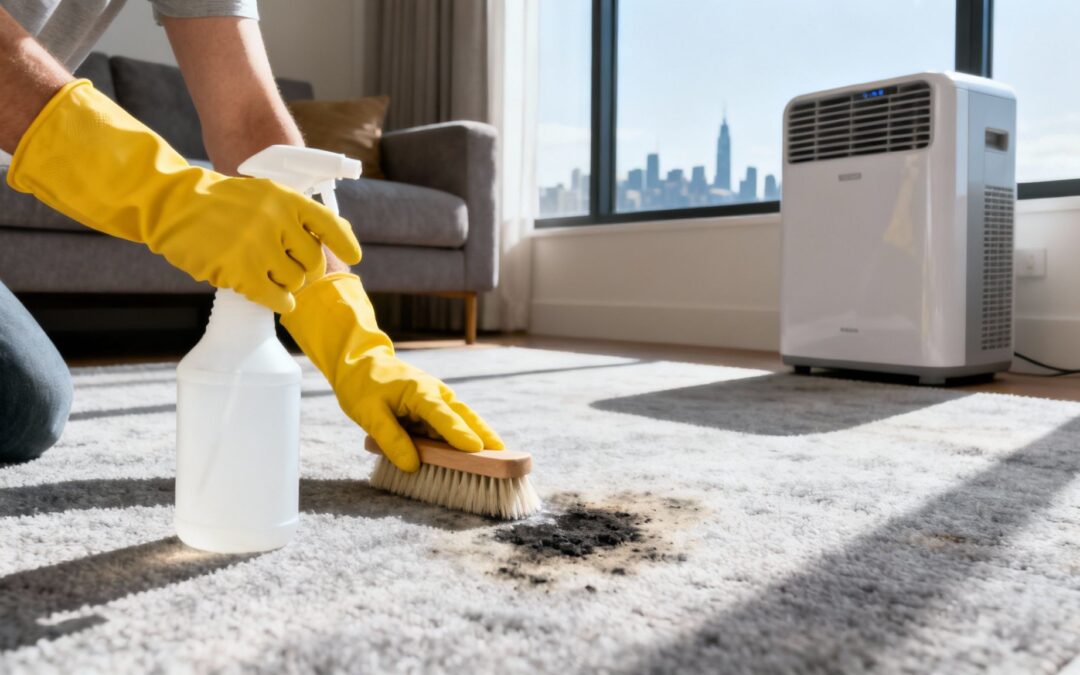
To get rid of mould in your carpet, the basic process is to thoroughly dry the area, apply a cleaning solution like a 1:1 mix of white vinegar and water, scrub the spot, and then—crucially—ensure the carpet is completely dried again to stop it from coming right back. While this DIY method works well for small, surface-level patches, extensive mould is a job for the professionals.
Why Melbourne Carpets Are So Prone to Mould
If you've ever caught that distinct musty smell or found a discoloured patch on your carpet, you're certainly not alone. It's a classic Melbourne problem. Our city's unique "four seasons in one day" climate creates the perfect storm for mould to thrive, turning our cosy homes into ideal breeding grounds.
Between the damp, chilly winters and the sudden, humid downpours, moisture is a constant battle for homeowners and renters alike.
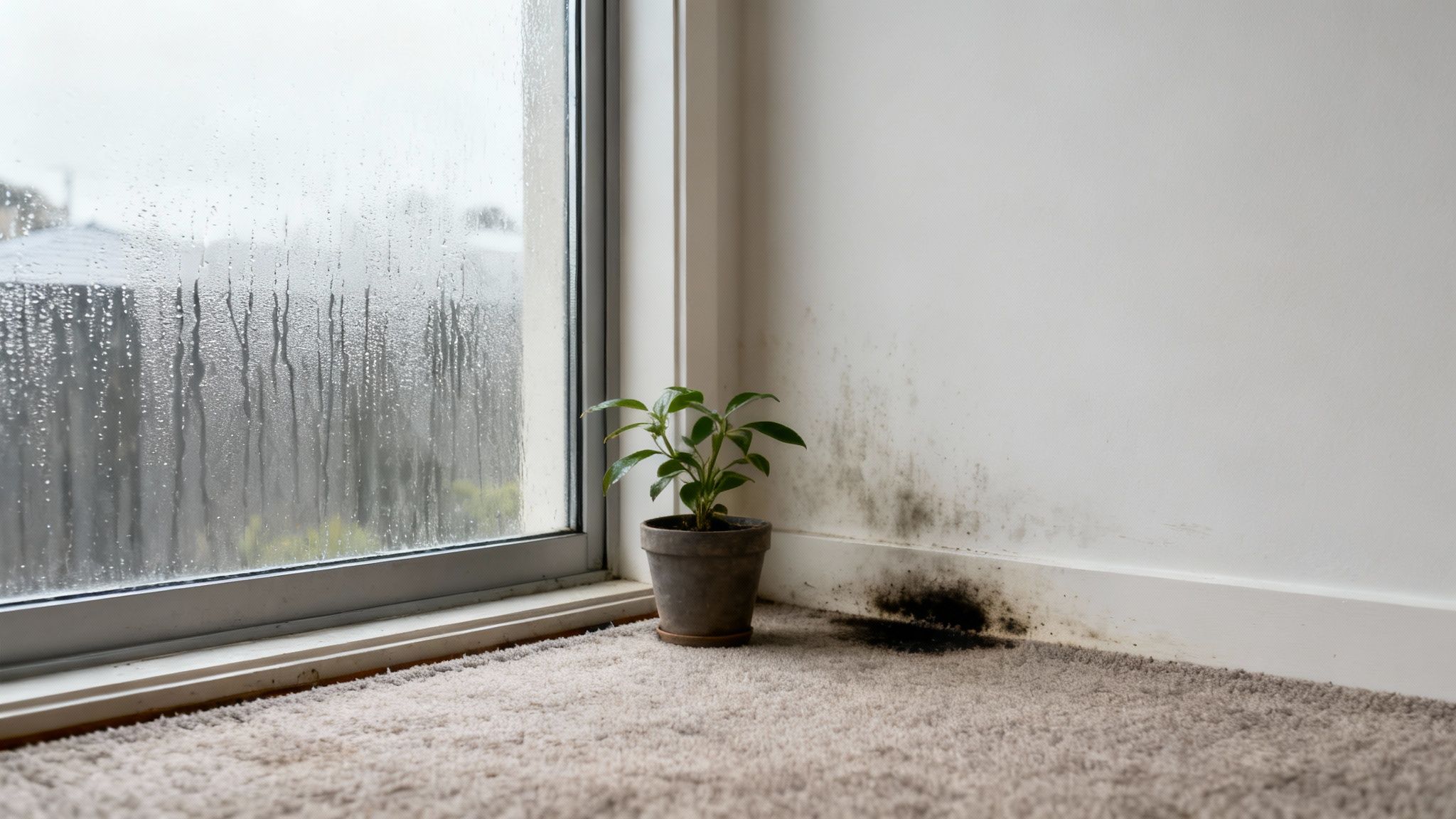
This persistent dampness finds its way into our homes in all sorts of sneaky ways. Think about the condensation that beads up on your windows on a cold morning, or a small, unnoticed leak from a pot plant. Even a simple spill that wasn't dried properly can be enough to kickstart a mould colony deep within your carpet fibres.
The Connection Between Climate and Carpet Health
Melbourne's weather patterns have a direct and unavoidable impact on our indoor humidity levels. When the air outside is cool and damp, the air inside follows suit, especially in older homes with less-than-perfect insulation or ventilation. This is exactly the environment mould spores need to activate and start growing.
Here’s how common Melbourne scenarios create the perfect mould-friendly conditions:
- Persistent Rain: Those long stretches of rain can saturate the ground around your home's foundation, leading to rising damp that seeps into subfloors and, eventually, your carpet underlay.
- High Humidity: On those warm, muggy days, the air holds a lot more moisture. Without good airflow from fans or open windows, that moisture settles right into porous surfaces like your carpet.
- Lack of Sunlight: Many modern apartments and homes have rooms that get very little direct sunlight, preventing carpets from ever fully drying out on their own.
The reality is that mould in Australian homes is a serious health concern. Studies show that between 10% and 50% of homes are affected, and a staggering 38.8% of surveyed cases of household mould came from Victoria.
This isn't just about looks; it's a genuine health hazard. Research backed by the CSIRO has highlighted how damp housing contributes to childhood asthma and allergies, with nearly 22% of respondents in one survey reporting severe mould problems. You can discover more insights about these housing and health findings from CSIRO Publishing.
From Minor Damp to Major Problem
A small patch of mould might seem like a minor annoyance, but it's a huge red flag signalling a deeper issue with moisture that you need to sort out.
If left untreated, mould can seriously compromise your home's air quality. It releases spores that can trigger allergic reactions, respiratory issues, and other health complications for your family. Understanding these risks is the first step in knowing how to get rid of mould in your carpet effectively—and why acting fast is so important.
Identifying Mold Growth in Your Carpet
Before you can tackle carpet mould, you first need to become a bit of a detective. Mould isn't always obvious; it doesn't just show up as big, ugly black spots. More often than not, the earliest signs are subtle and easily missed until the problem has well and truly set in.
Catching mould in its early stages is absolutely crucial. A small, manageable patch can quickly escalate, ruining your carpet, degrading your home's air quality, and even impacting your family's health. You'll need to use more than just your eyes—your sense of smell and touch are your best allies here.
Trust Your Senses: The Early Warning Signs
Many Melbourne homeowners first suspect mould not because they see it, but because they can smell it. That persistent, musty odour that reminds you of a damp basement or wet soil is a classic tell-tale sign. If a room smells stale and earthy, especially after being closed up for a while, it’s time for a closer look.
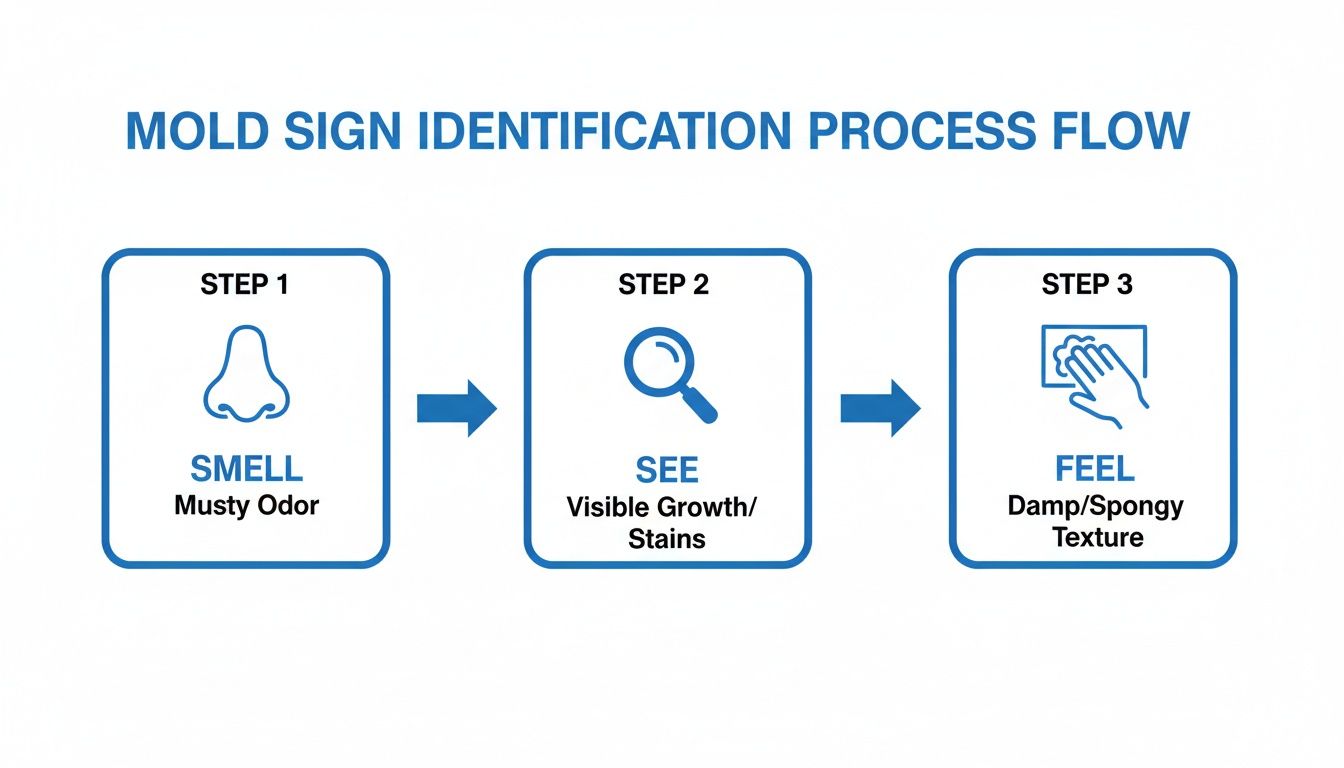
Another critical indicator can be your own health. Are you or your family members suddenly dealing with unexplained allergy-like symptoms—sneezing, coughing, itchy eyes, or a runny nose—that seem to get worse in a specific room? Airborne mould spores could be the culprit.
This isn't just an inconvenience; it's a serious health concern. According to a 2022 survey by Asthma Australia, a shocking 50% of Australian respondents reported having mould or dampness in their home over the last year. This directly increases asthma risks, especially when porous items like carpets are affected by leaks or floods—a common story during Melbourne’s wetter seasons. You can read the full findings on asthma and household mould from Asthma Australia for more details.
Your Mold Identification Checklist
It helps to have a quick reference when you're on the hunt for hidden mould. Use this table to track what your senses are telling you.
| Symptom | What It Could Mean | Where to Check First |
|---|---|---|
| Musty, earthy smell | This is the classic odour of active mould growth (mycotoxins). | Check behind furniture, in corners, and near exterior walls. |
| Visible discolouration | Green, black, grey, or white fuzzy patches on the carpet fibres. | Lift the corners of the carpet to inspect the backing and underlay. |
| Damp or spongy feel | The carpet or underlay feels cool, wet, or squishy to the touch. | Press down firmly in areas near windows, doors, or in basements. |
| Worsening allergies | Sneezing, coughing, or itchy eyes that flare up in a specific room. | This points to airborne spores, often from a hidden source. |
Remember, any one of these signs is enough to warrant a more thorough investigation.
Common Hiding Spots for Carpet Mould
Mould loves dark, damp, and undisturbed places. It rarely grows out in the middle of a high-traffic area. Instead, you need to check the spots where moisture is likely to gather and linger unnoticed.
Start your inspection in these key areas:
- Underneath Furniture: Pull back couches, entertainment units, and bookshelves that sit right on the floor. These spots trap moisture and block airflow, creating the perfect habitat for mould.
- Along External Walls: Carpets butting up against exterior walls, particularly those that get little sun, are prone to dampness from condensation or small leaks.
- Near Windows and Doors: Condensation runoff from window frames is a common culprit, seeping directly into the carpet below.
- In Basements or Sub-Floor Rooms: Any carpet laid in a below-ground area is at a much higher risk due to natural humidity and potential rising damp.
When you inspect these areas, get right down on the floor. Use a torch to light up the fibres. You’re looking for subtle discolouration—patches that might look grey, greenish, black, or even white and fluffy.
Don't just look for classic "black mould." Mould comes in a whole rainbow of colours and textures. Any unusual staining or fuzzy growth on your carpet that you can't explain with a simple spill needs a much closer look.
Finally, use your sense of touch. Press down firmly on the carpet and, if you can, the underlay beneath it. Does it feel cool, damp, or spongy? Lingering dampness is the number one ingredient for mould growth. If the carpet doesn't feel completely dry, you've likely found your problem area. A damp carpet is a breeding ground just waiting to happen.
A Practical Guide to DIY Mould Removal
So, you've spotted a small patch of mould on your carpet. If it’s just on the surface and covers an area smaller than one square metre, you can often handle it yourself with the right approach. It’s all about being methodical, putting safety first, and being incredibly thorough.
Before you even think about grabbing a cleaning solution, your first job is to protect yourself and get some fresh air flowing. Mould spores are microscopic and become airborne the second you start disturbing them. Breathing them in is a fast track to allergies and respiratory problems, so gearing up properly isn't just a suggestion—it’s non-negotiable.
Setting Up a Safe Workspace
First things first, you need to create a safe work zone. Throw open all the windows and doors in the room to get some cross-ventilation going. If you’ve got a portable fan, point it out an open window. This helps pull the airborne spores outside instead of just blowing them around the room.
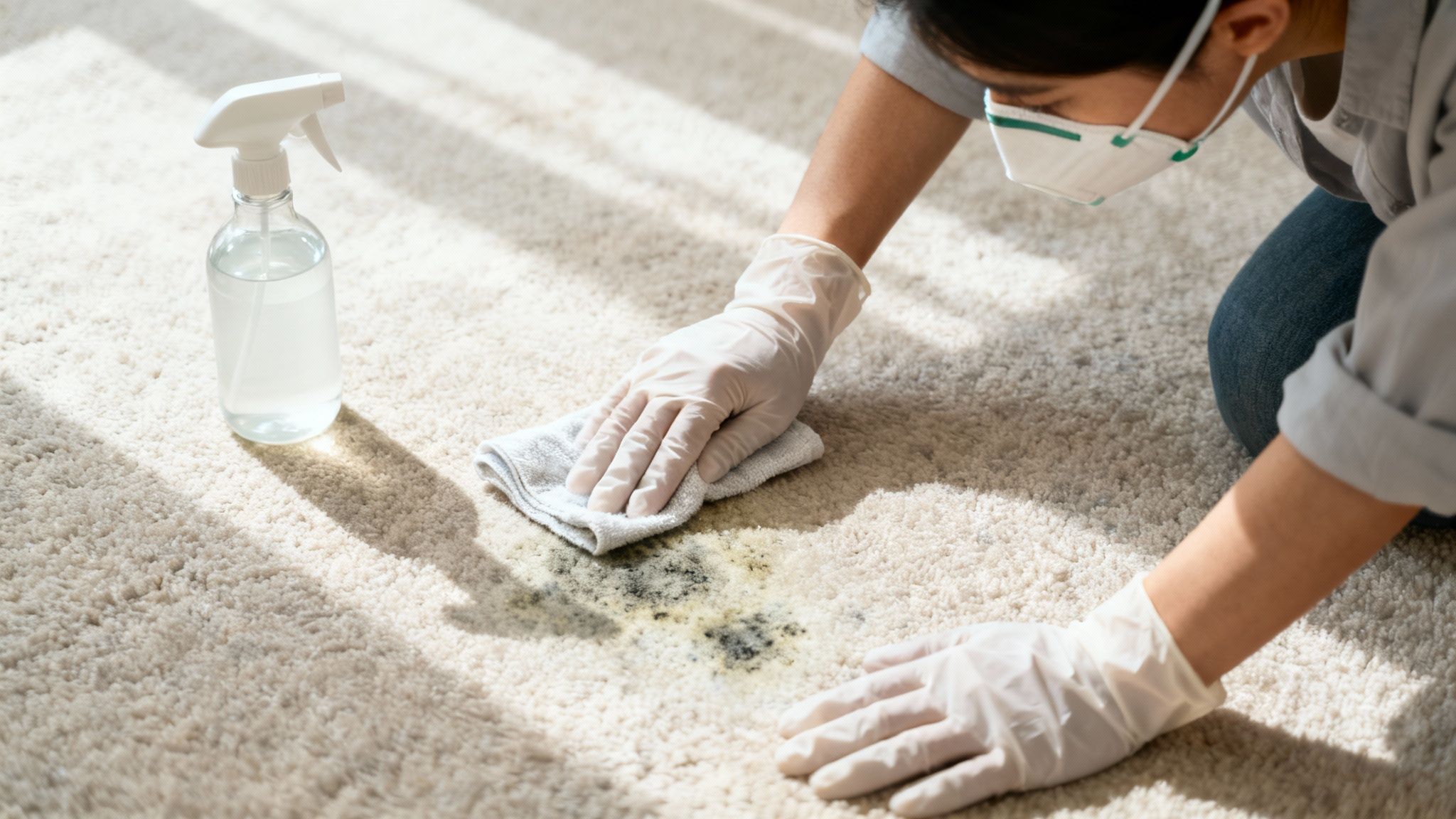
Next, it's time to assemble your personal protective equipment (PPE). Don't skip this part. You'll absolutely need:
- An N95 Respirator Mask: A standard dust mask is not going to cut it. You need a properly fitted N95 to filter out those tiny mould spores.
- Gloves: Go for long, disposable rubber or nitrile gloves that come up over your wrists.
- Eye Protection: A pair of goggles will stop spores from getting into your eyes.
Once you’re kitted out, you’re ready to tackle the cleaning.
Choosing Your Cleaning Solution
It’s tempting to reach for the bleach, but for carpets, this is a classic mistake. Bleach is great for hard, non-porous surfaces, but it can't get deep enough into carpet fibres or the backing to kill the mould's roots. All it really does is strip the colour from the surface, tricking you into thinking the problem is solved when it’s still lurking underneath.
Believe it or not, some simple, natural solutions work much better for this job.
- White Vinegar: The acetic acid in white vinegar is a fantastic mould-killer. It’s able to penetrate porous surfaces and get to the source of the problem.
- Baking Soda: This is your go-to for absorbing moisture and getting rid of that lingering musty smell.
To create a powerful cleaning combo, mix one part white vinegar with one part water in a spray bottle. This is going to be your main weapon against the mould.
The Correct Application Technique
How you apply the cleaner is just as important as what you use. Scrubbing too aggressively will only damage your carpet fibres and push the spores deeper into the backing. A gentle but firm approach is what you need.
Start by sprinkling a generous amount of dry baking soda directly over the mouldy patch. Just let it sit there for at least an hour—overnight is even better if you can. The baking soda will start pulling moisture out of the carpet and soaking up that musty odour.
Once it's had time to work, grab a vacuum cleaner fitted with a HEPA filter. This is crucial because a HEPA filter is fine enough to trap the tiny mould spores you've loosened, stopping them from being shot back out into the air. Vacuum the area thoroughly.
Now it’s time for your vinegar solution. Lightly spray the 1:1 vinegar and water mix onto the remaining stain. Don't drench it; you just want it damp. Let the solution sit for five to ten minutes to give the vinegar time to kill off the mould.
Next, take a stiff-bristled brush and gently work the area in small, circular motions to loosen the mould from the fibres. After that, switch to a clean, dry cloth or paper towel and start blotting. Blot, don't scrub. This lifts the mould and moisture up and out of the carpet. Keep blotting with fresh cloths until the spot feels as dry as you can get it.
Ensuring a Completely Dry Finish
I can't stress this last part enough: if you leave any moisture behind, the mould will come right back. The carpet must be 100% dry before you can call the job done.
Set up some fans pointing directly at the damp patch to keep the air moving. A dehumidifier running in the room will also speed things up significantly. If the damp spot is near a wall, you can even carefully lift the corner of the carpet and prop it up on something small to let air circulate underneath to the backing and underlay.
Depending on the humidity in your Melbourne home, this could take a few hours or a full day. Be patient. Test the area by pressing a dry paper towel firmly into the carpet. If it picks up any dampness, keep the fans on. Only when it’s bone-dry is the job truly finished.
When Your Mould Problem Requires a Professional
Knowing your limits is a huge part of dealing with carpet mould safely. While you can often tackle a small, contained spot on your own, there are some very clear red flags that mean it's time to put down the spray bottle and call in a professional. Pushing ahead on your own in these situations isn't just a waste of time; it can be downright dangerous for your health and your home.
Recognising these warning signs isn't about admitting defeat. It’s the smartest move you can make to ensure the problem is dealt with completely, protecting your family and your property from much bigger headaches down the track.
The One Square Metre Rule
There’s a widely accepted guideline in the cleaning and restoration industry for a very good reason. If the visible mould covers an area larger than one square metre—think roughly the size of a large bath towel—it's no longer a DIY job.
A patch that large is a dead giveaway that you’re dealing with a significant underlying moisture problem, one you can't solve with household cleaners. Professionals come equipped with proper containment gear and specialised air filtration devices (like air scrubbers) to stop millions of spores from becoming airborne and contaminating your entire home during the removal process.
When the Mould Just Keeps Coming Back
So, you followed all the DIY steps perfectly. You cleaned, you dried, you aired everything out, and you thought you’d won the battle. But a few weeks later, that familiar musty smell returns, and the dark spots start creeping back. It’s one of the most frustrating scenarios for any homeowner.
Recurring mould is a sure sign that a surface-level clean didn't get to the root of the problem. It means spores have likely worked their way deep into the carpet backing, the underlay, or even the subfloor itself. At this stage, only professional-grade equipment has the power to truly get rid of the infestation for good.
Calling in a professional is often the most cost-effective decision in the long run. Repeated, failed DIY attempts can spread spores further, leading to a much larger and more expensive remediation project down the track.
The Power of Professional Equipment
It’s tempting to think that a rental machine from the local supermarket can deliver a professional-level clean, but the difference is night and day. Those machines simply can't compete with the heavy-duty technology used by trained technicians.
- Truck-Mounted Steam Cleaners: These are industrial-strength units powered by a vehicle's engine. They heat water to much higher temperatures than any portable machine, creating powerful steam that kills mould spores on contact and sanitises deep within the fibres.
- Powerful Extraction: The real game-changer is the vacuum suction. A truck-mounted system has incredible extraction power, pulling moisture, dead spores, and deep-seated grime out of the carpet, backing, and underlay. This leads to dramatically faster drying times, which is critical for stopping mould from returning.
- Specialised Treatments: Professionals also have access to antimicrobial and antifungal treatments that are far more effective than anything you can buy off the shelf. These create a lasting barrier against future mould growth.
This is especially important here in Melbourne, where our damp winters can make carpets a prime target for mould. In fact, the demand for professional mould remediation is on the rise across Australia. Getting rid of mould properly is a major health win—recent estimates suggest it can add 1.5 extra healthy days per person over 20 years by cutting down on respiratory issues linked to damp homes. You can discover more about the health benefits of mould eradication via Medical Xpress.
Major Water Damage Scenarios
If the mould growth is the result of any kind of significant water damage, don't even think about a DIY fix. This is a job for the pros, no question. These situations include:
- Flooding from outside: This water is considered "black water" and is contaminated with everything from sewage and chemicals to bacteria. It's a serious biohazard.
- A burst pipe or major leak: If water has saturated a large area of carpet for more than 24-48 hours, mould growth is pretty much guaranteed in the underlay and subfloor.
- Sewage backup: This is another black water event that demands immediate professional intervention to safely remove, clean, and sanitise all affected materials.
In these cases, the carpet and underlay often need to be carefully removed and disposed of to prevent cross-contamination. Professionals have the right training and personal protective equipment (PPE) to handle these hazardous materials safely, protecting your home from a much bigger health crisis.
Keeping Your Carpets Mold-Free for Good
Getting rid of mould in your carpet is a huge relief, but the job isn’t truly done until you put a solid prevention plan in place. The real goal is to make sure that musty smell and those ugly spots never come back. This calls for a proactive approach, especially here in Melbourne where dampness can be a constant battle for much of the year.
Think of it this way: mould only shows up when your home’s moisture control breaks down. By focusing on a few key habits, you can create an environment where mould simply can’t get a foothold. It’s all about shifting from a reactive clean-up to a preventative mindset.
Master Your Indoor Climate
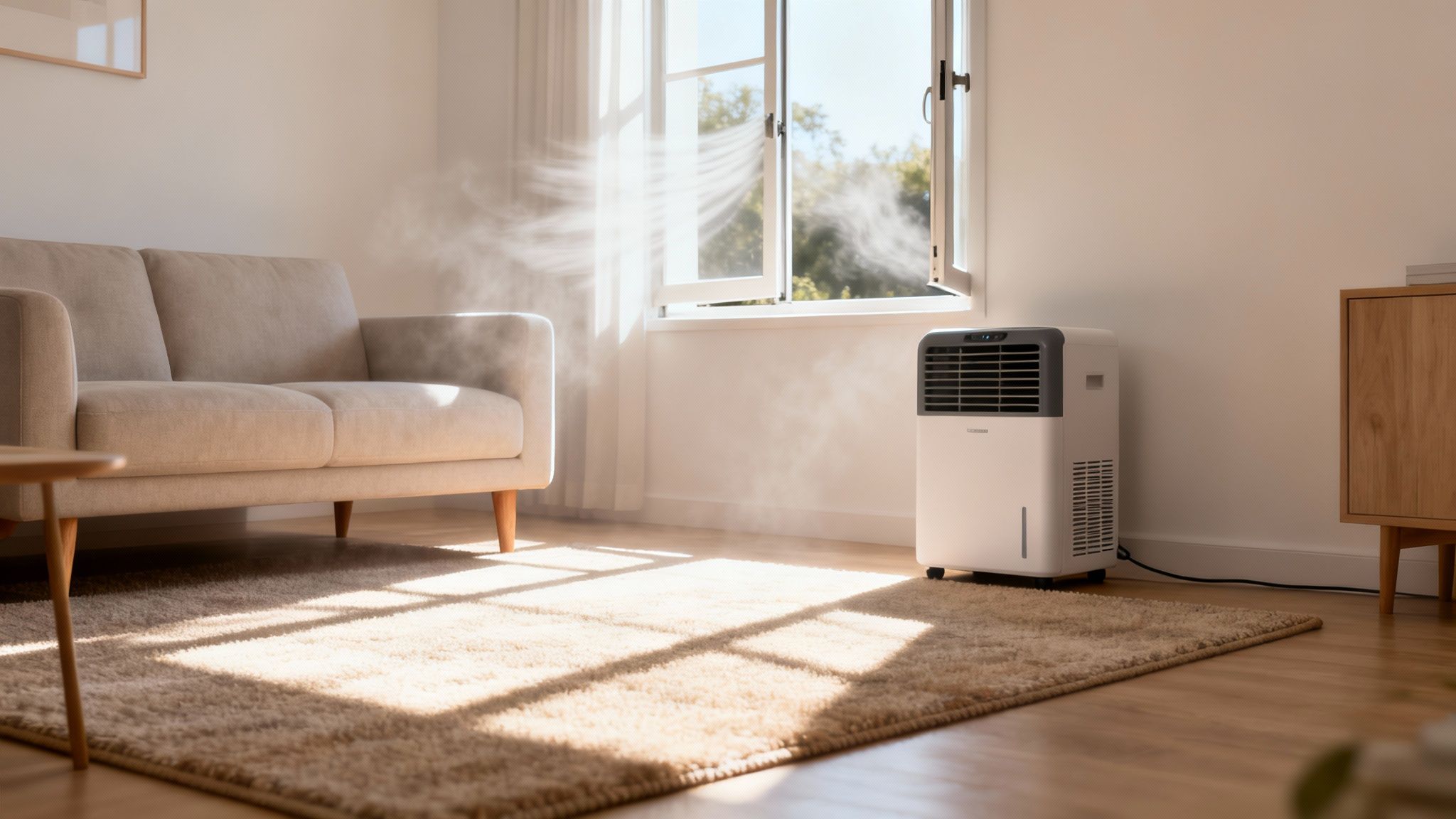
Your single most powerful weapon against carpet mould is controlling your indoor humidity. Mould needs moisture to grow, period. In a city like Melbourne, where the air can feel heavy and damp for weeks on end, managing the air inside your home is absolutely critical.
- Improve Air Circulation: Stagnant air is damp air. Make it a daily habit to open windows on opposite sides of your home for at least 15-20 minutes. This creates a cross-breeze that flushes out the stale, moist air. Don’t forget to use ceiling or portable fans to keep things moving, particularly in rooms with poor airflow.
- Targeted Ventilation: Some rooms are natural moisture factories. Always, always run the exhaust fan in your bathroom during a shower and for about 20 minutes after. Do the same with your kitchen’s rangehood when you’re cooking to vent steam outside.
- Strategic Dehumidifier Use: A good dehumidifier is a brilliant investment for Melbourne homes. Pop it in those naturally damp spots like basements, laundries, or any room that gets very little sun. Your goal is to keep the relative humidity in your home between 30% and 50%.
By actively managing your home's airflow and humidity, you're not just preventing mould; you're creating a healthier, more comfortable living space. It's a small daily effort that pays huge dividends in carpet longevity and air quality.
Act Fast on Spills and Leaks
Even with perfect humidity control, life happens. A knocked-over drink or a leaky pot plant can provide just enough moisture to kickstart a mould colony if you don’t deal with it immediately. The key is to act fast and dry it out completely.
When a spill occurs, don’t just dab the surface. Grab a thick, dry towel, place it over the wet spot, and stand on it. This uses your body weight to pull moisture up from deep within the fibres and underlay. For bigger spills, a wet-dry vac is your best friend. Afterwards, point a fan directly at the spot for several hours until it's bone-dry to the touch.
Of course, it's also fundamental to fix the source of any water issues, which is why homeowners should know how to repair water leakage promptly. Even a tiny, slow drip from a pipe can saturate the underlay over time, creating a hidden mould factory right under your feet.
Schedule Regular Professional Deep Cleans
Lastly, start thinking of professional carpet cleaning as a powerful preventative tool, not just a fix for stains. Day in and day out, your carpet traps microscopic dirt, skin cells, and dormant mould spores—the perfect food source for a future infestation.
A proper steam clean from a professional does more than just make your carpets look nice. The combination of high-temperature steam and powerful extraction achieves three crucial things:
- It Kills Dormant Spores: The intense heat sanitises deep into the carpet pile, killing off any lingering spores from your last clean-up.
- It Removes Mould's Food Source: The deep clean flushes out the embedded dirt, dust, and organic gunk that mould needs to survive.
- It Ensures Rapid Drying: Professional truck-mounted machines have incredible suction power. They extract almost all the water, meaning your carpets dry quickly and don't create the damp conditions that cause mould in the first place.
Booking in a deep clean every 12 to 18 months is like hitting the reset button. It safeguards your investment and helps ensure your home’s air stays clean and healthy for the long haul.
Common Questions About Carpet Mould
When you find mould in your carpet, it’s natural to have a lot of questions. Honestly, dealing with it can feel a bit overwhelming, so I've put together some of the most common queries we hear from Melbourne residents. Here are some clear, straightforward answers to help you make the right call for your home.
Can I Use a Supermarket Carpet Cleaner on Mould?
While those supermarket cleaners are fantastic for everyday spills and stains, they just aren't designed to kill mould spores deep within the carpet fibres. In fact, they often add more moisture without the powerful extraction needed to pull it all back out.
This can actually make the underlying problem worse by feeding the mould colony. It's a classic case of a temporary fix causing a long-term headache.
Professional steam cleaning is a completely different ball game. We use extremely high heat to kill the spores and industrial-strength suction that no rental machine can ever hope to match. That power is absolutely critical for proper mould remediation.
Does Mould Mean I Have to Replace My Carpet?
Not always. If the mould is confined to the surface and you’ve caught it early, a professional clean can often save the carpet. An expert can effectively get rid of the mould without you needing to rip everything up and start again.
However, if the mould has penetrated the carpet backing and underlay, or if it was caused by contaminated water (like from a flood or sewage leak), replacement is usually the safest option. Any honest professional will assess the extent of the damage and give you a clear, no-nonsense recommendation.
A common concern for homeowners facing this is the cost of remediation and whether their insurance will cover it. For a detailed look into this, it’s helpful to understand if Does homeowners insurance cover water damage?, as policies can vary significantly.
Is My Landlord Responsible for Mould in a Rental?
In Victoria, landlords have a legal responsibility to ensure a rental property is in good repair. If the mould growth is coming from a structural issue—think a roof leak, rising damp, or faulty plumbing—the landlord is typically on the hook for fixing the source and addressing the damage.
The most important thing you can do is notify your landlord or property manager in writing as soon as you discover the issue. Document everything with photos and keep a clear record of all communication. It's the best way to protect your rights as a tenant.
How Long Does Professional Carpet Cleaning Take to Dry?
Getting carpets dry quickly is one of the biggest factors in preventing mould from coming straight back. While older methods could leave carpets damp for days on end, modern professional equipment is designed for speed and efficiency.
Our truck-mounted machines extract the vast majority of water during the cleaning process itself. Depending on your home's ventilation and the classic Melbourne weather, your carpets are typically dry to the touch in 4-6 hours and fully dry within 24 hours. This is a massive advantage over DIY rental machines, which often leave carpets far too wet for far too long.
Dealing with mould can be a tricky business, but you don't have to handle it alone. For a safe, thorough, and guaranteed solution, trust the experts at Right Price Carpet Cleaning. We use powerful truck-mounted steam cleaning to eliminate mould and restore the health of your home. Get your instant online quote and book your service today!
Recent Comments