



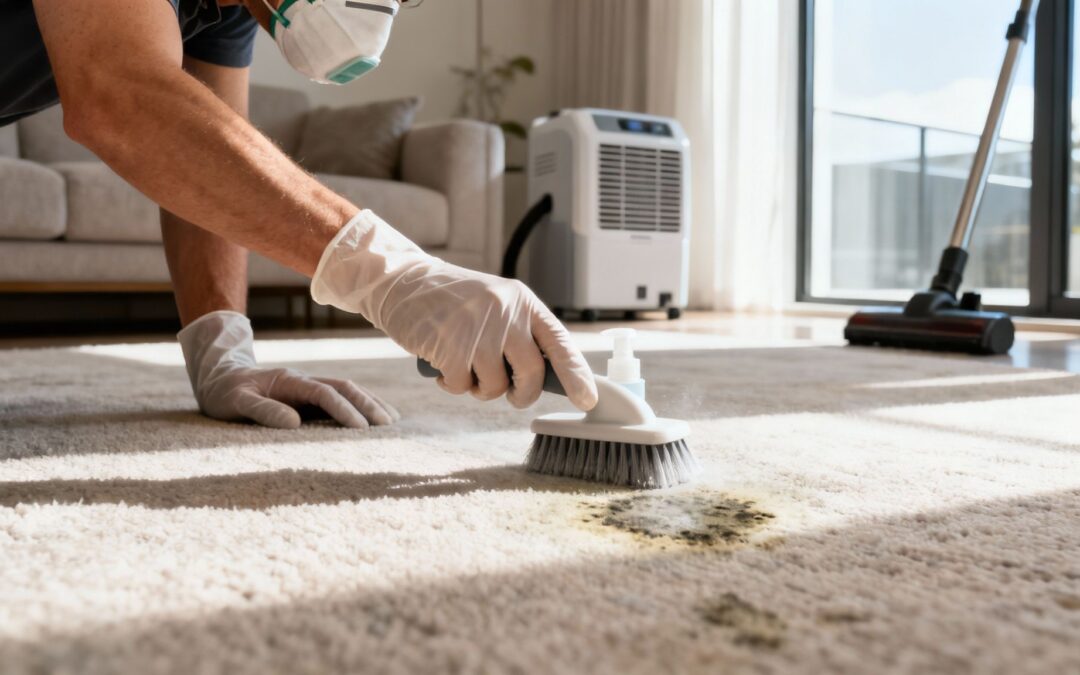
That musty smell you just can't seem to pinpoint? It’s not your imagination. More often than not, it's the first clue you have a carpet mould problem, an all-too-common issue for Melbourne homeowners.
For small affected areas, getting rid of it can be a manageable DIY job. The secret is to first eliminate the source of moisture, then treat the spot with a simple solution like white vinegar, and finally, dry the area completely to stop it from coming back.
Why Melbourne's Climate Creates the Perfect Storm for Carpet Mould
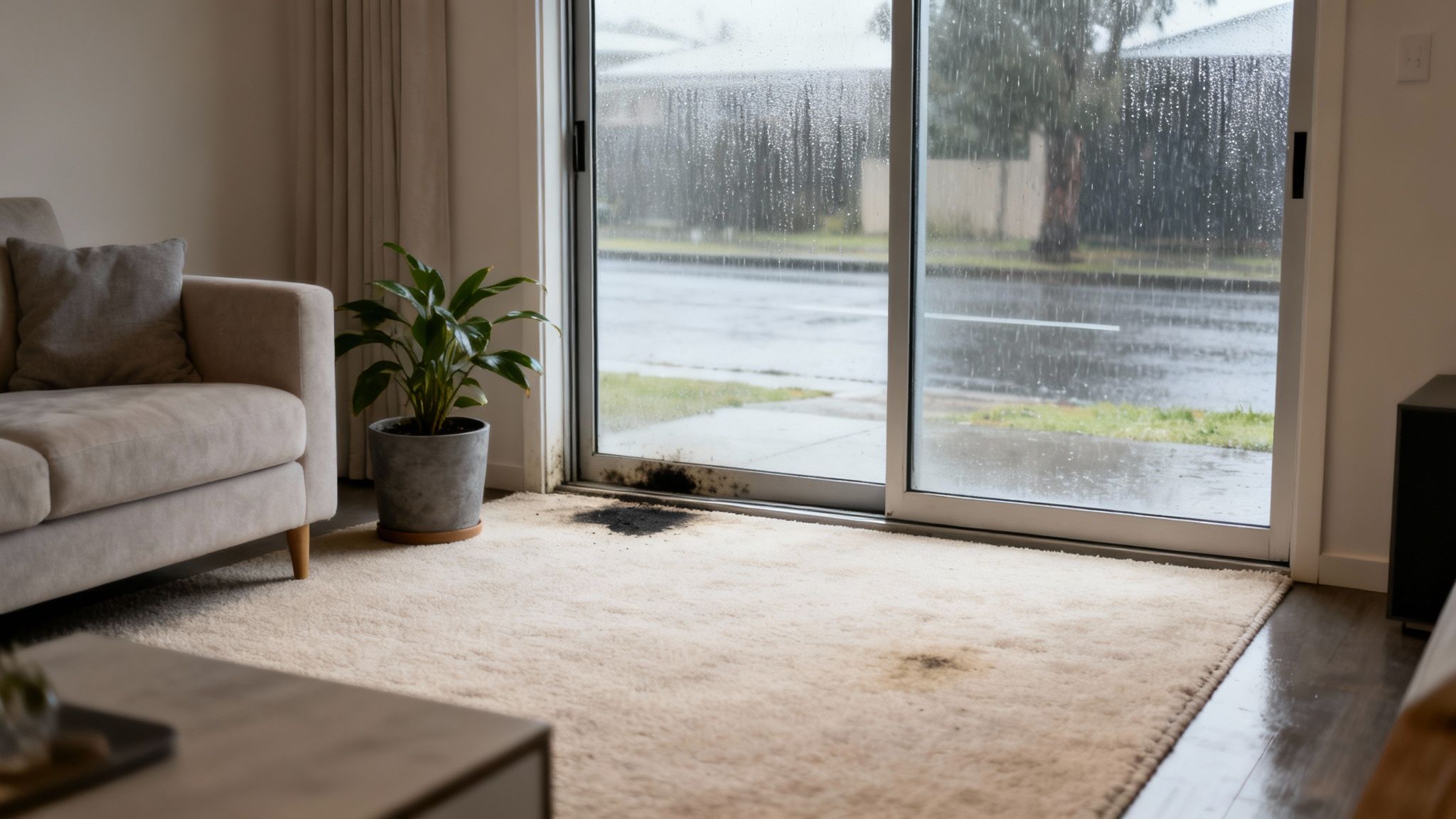
Melbourne is famous for its "four seasons in one day," but that charming unpredictability is exactly what makes our homes such a prime breeding ground for mould. The city’s persistent dampness, high humidity, and sudden downpours create an environment where mould spores don't just survive—they thrive.
These microscopic spores are always in the air, floating around harmlessly. But the moment they land on a damp, organic surface like your carpet fibres, they take root and start to multiply. It doesn't take much; a slow window leak, a spill that wasn't dried properly, or even just condensation from a cold, rainy day can provide enough moisture to kickstart a colony.
The Hidden Impact on Melbourne Homes
The real danger is what you can't see. While a small, visible patch of mould might seem like a minor issue, it often signals a much bigger problem lurking in the carpet's underlay or even the subfloor. This hidden growth silently degrades your flooring and pumps spores into your home's air.
For families—especially those with young children, elderly members, or anyone with respiratory conditions like asthma—this can turn into a serious health concern. Ongoing exposure to airborne mould spores can trigger a range of frustrating issues:
- A persistent cough or wheezing
- Itchy eyes, skin rashes, and irritation
- Worsening asthma and allergy symptoms
- Headaches and a general sense of fatigue
A recent CSIRO study really drove home how big this issue is locally. It revealed that a staggering 38.8% of surveyed mould-affected households were right here in Victoria. Even more concerning, 21.7% reported severe infestations often embedded deep within their carpets. Alarmingly, private renters, who make up 55.2% of those impacted, face the highest risk of exposure.
Identifying the Telltale Signs
Before you can fix the problem, you need to know exactly what you’re looking for. Mould isn't always an obvious black or green fuzzy patch. Sometimes it starts with just a faint smell or a slight change in your carpet's texture.
Not sure what to look for? This quick guide breaks down the early warning signs to help you diagnose a potential mould problem before it gets out of hand.
Quick Guide to Identifying Carpet Mould
| Symptom | What It Looks Like/Smells Like | What It Means for Your Carpet |
|---|---|---|
| Musty Odour | An earthy, damp smell, like a wet basement or old books. It’s often strongest after the room has been closed up. | This is the most common early sign. It means mould is actively growing and releasing microbial volatile organic compounds (MVOCs). |
| Discolouration | Patches of green, black, white, or even yellow fuzz appearing on the surface. Can also look like a stubborn stain that keeps reappearing. | This is visible mould growth. The colour can vary depending on the mould species and the type of material it is feeding on. |
| Dampness | The carpet feels persistently damp or spongy to the touch, even when there hasn't been a recent spill. | This indicates an ongoing moisture problem, which is the root cause of the mould. The source could be a leak, condensation, or high humidity. |
| Allergy Flare-Ups | Unexplained increases in sneezing, coughing, or other allergy-like symptoms when you are in a specific room. | Your body may be reacting to airborne mould spores. If symptoms improve when you leave the house, the indoor air quality is a likely culprit. |
Once you’ve used these clues to confirm your suspicions, the next step is to find the source of the moisture. While spills and humidity are common culprits, don't forget to look up.
Beyond environmental factors, structural issues like roof leaks are a major source of unwanted moisture. Understanding the benefits of regular roof inspections can help you prevent the kind of serious water damage that feeds carpet mould. Catching these problems early is absolutely key to keeping your home dry and your carpets mould-free.
Evaluating the Mold Damage: Can You DIY or Do You Need a Pro?
Before you start mixing up cleaning solutions or pulling on gloves, the single most important thing you can do is pause. You need to accurately assess the mold situation. Deciding whether to tackle carpet mold yourself or call in the professionals is a critical judgement call that protects both your health and your home.
Honestly, making the wrong choice here can lead to a much bigger, more expensive problem down the track.
The real difference between a DIY-friendly issue and a job for the experts comes down to two things: size and depth. Think of it like this—a small, isolated patch of surface mold, maybe the size of a dinner plate under a pot plant you overwatered, is often manageable. But if the mold stretches across a significant part of the room, or if you suspect it's been festering for weeks after a slow leak, you're stepping into professional territory.
The Litmus Test for DIY Mold Removal
A good rule of thumb we use in the industry is the one square metre rule. Most experts agree that if the visible mold covers an area smaller than one square metre and seems confined to the carpet surface, a careful DIY approach can work.
But size isn't the only factor. You also have to think about the source of the moisture. Was it a one-off spill that you can confidently say is now bone dry? Or is it the result of persistent damp from a leaky pipe or high humidity that hasn't been fixed? If the underlying moisture problem is still active, any cleaning you do will just be a temporary fix.
You should feel confident handling the mold yourself if:
- The affected area is small and contained (less than 1 square metre).
- The mold appears to be only on the surface of the carpet fibres.
- You have identified and completely resolved the source of the moisture.
- No one in your household has severe allergies, asthma, or a compromised immune system.
Red Flags That Signal It's Time for a Professional
Sometimes, what you see on the surface is just the tip of the iceberg. The real danger with carpet mold is what’s happening underneath—in the carpet backing, the underlay, and even the subfloor. Once mold penetrates these layers, it becomes nearly impossible to remove completely without specialised equipment.
Here are the undeniable signs that you need to put down the spray bottle and pick up the phone:
- Widespread Growth: The mold covers an area larger than one square metre.
- A Stubborn, Earthy Smell: If a strong musty odour persists even after airing out the room, it's a huge red flag that mold is growing deep within the carpet structure.
- The Mold Returns: You've cleaned the area thoroughly, but the discolouration or smell comes back. This means the roots of the mold were never fully eliminated.
- Saturated Carpets: If the carpet was soaked due to a flood, major leak, or burst pipe and wasn't dried professionally within 24-48 hours, you have to assume the underlay is compromised.
- Soft or Spongy Underfoot: Does the floor feel soft or squishy around the moldy area? This could mean the underlay and even the subfloor have suffered serious water damage.
Before deciding if you can handle the mold yourself or if professional help is needed, it's often wise to consult a comprehensive external mold testing guide to understand the full scope of the problem. Testing can reveal the type and concentration of mold spores, giving you a clearer picture of the health risks involved.
Underestimating a significant mold problem is a common and costly mistake. Professionals have the tools—like industrial-strength dehumidifiers, air scrubbers, and hot water extraction machines—to not only kill the mold but also safely remove the spores and moisture that DIY methods almost always leave behind. This ensures the problem is solved for good, protecting your investment and your family's wellbeing.
So, you’ve found a small patch of mould on your carpet—less than a square metre—and you're thinking of tackling it yourself. Good on you. For small, surface-level problems, a DIY approach can work wonders, but it's not as simple as just scrubbing a stain. You need to be methodical to remove the spores safely without sending them airborne and making things worse.
First things first: your safety. Before you even touch a cleaning bottle, you need to get your personal protective equipment (PPE) sorted. Mould spores are microscopic and get into the air easily, which can cause respiratory issues or set off allergies. Honestly, skipping this step is just not worth the risk.
Your Essential Safety Toolkit
Think of this gear as your shield against an invisible threat. Don't cut corners here.
- P2/N95 Respirator Mask: A standard dust mask is not going to cut it. You need a proper respirator designed to filter out tiny particles like mould spores.
- Safety Goggles: These will protect your eyes from stray spores and any cleaning solution that might splash.
- Rubber Gloves: A sturdy pair that covers your wrists is essential to stop mould and cleaning agents from touching your skin.
This flow diagram shows exactly how a small, seemingly harmless spot can escalate if the moisture source isn't dealt with.
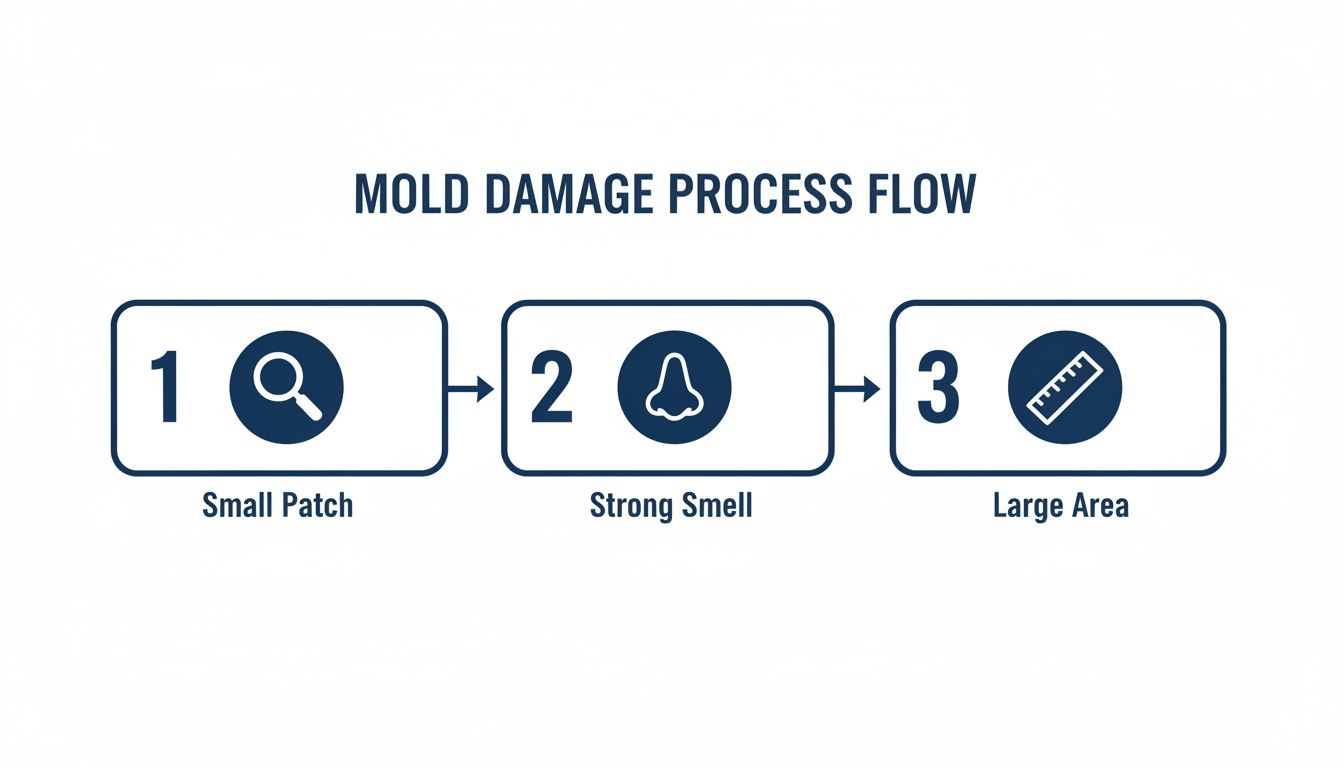
As you can see, a little patch often leads to that classic musty smell, which is a dead giveaway that the problem is growing, even if you can't see it yet.
Once you’re geared up, it's time to contain the area. Shut the doors to the rest of the house and crack open a window in the room you're working in. This helps create a draft that pushes any disturbed spores outside instead of letting them settle elsewhere in your home.
The Right Tools for Effective Mold Removal
Let's talk cleaning. The first thing people grab is usually bleach, but this is a massive mistake. Bleach can ruin your carpet fibres, causing discolouration. More importantly, it often doesn't kill the mould's roots, meaning it’ll just grow back.
A far better and safer approach for your carpet involves using natural solutions that actually get to the source of the problem.
Expert Tip: Whatever you do, don't use your regular vacuum cleaner on a mould patch. It’ll just suck up the spores and shoot them right back out the exhaust, spreading them everywhere. Only use a vacuum that’s fitted with a HEPA filter, which is specifically designed to trap these microscopic nasties.
Applying a Natural Cleaning Solution
White vinegar is a brilliant weapon against surface mould on carpets. Its acidity is fantastic for breaking down the structure of many common indoor moulds.
- Mix your solution. Grab a spray bottle and mix one part white vinegar with one part warm water. You're aiming for damp, not drenched, so don't go overboard.
- Spray and wait. Lightly mist the mouldy area, going about 15 centimetres past the visible edge just in case it has started to spread unseen. Let it sit for at least an hour. This gives the vinegar time to really get in there and do its job.
- Time for some elbow grease. Using a stiff-bristled brush, gently scrub the area in small circles. You want to be firm enough to lift the mould out of the fibres but not so aggressive that you damage the carpet pile.
- Blot it dry. Use some clean, dry cloths or paper towels to blot the area and soak up as much moisture as you can. The key is to get the carpet dry as quickly as possible.
Once you're done cleaning, sprinkle a liberal amount of baking soda over the still-damp patch. Let it sit for a few hours (or even overnight). It’s great for absorbing any leftover moisture and neutralising that musty smell. Once the carpet is completely bone dry, you can vacuum up the baking soda with your HEPA-filtered vacuum.
Final Checks and Monitoring
Alright, the spot is clean, but you're not quite done. For the next few weeks, keep a close eye on that area. Look for any hint of regrowth and have a sniff for that damp, earthy smell.
If the mould returns, it's a pretty clear sign the problem is deeper—likely in the carpet backing or underlay. At that stage, you’re beyond a simple DIY job. It’s time to call in the professionals who have the gear to properly assess and treat what’s going on underneath.
Mastering the Drying Process to Prevent Mould's Return
Scrubbing away visible mould is satisfying, but it's only half the battle. The real victory comes from eliminating the one thing mould can't live without: moisture. If you leave the carpet even slightly damp, you’re essentially rolling out the welcome mat for a swift and frustrating return of those unwanted spores.
This drying phase is non-negotiable and requires a strategic approach, especially given Melbourne's often humid and unpredictable climate. Simply blotting the area and hoping for the best is a recipe for failure. You need to actively and aggressively pull every last bit of moisture from the carpet fibres, the backing, and even the underlay.
Without a thorough drying process, you're not solving the problem; you're just pausing it. Think of it like pulling a weed but leaving the root—it's only a matter of time before it grows back.
Creating a Low-Humidity Environment
Your main goal is to create an environment that is actively hostile to mould growth. In practical terms, this means getting your room's relative humidity down and keeping it there until the carpet is completely bone dry. Aiming for an indoor humidity level between 30% and 50% is the sweet spot.
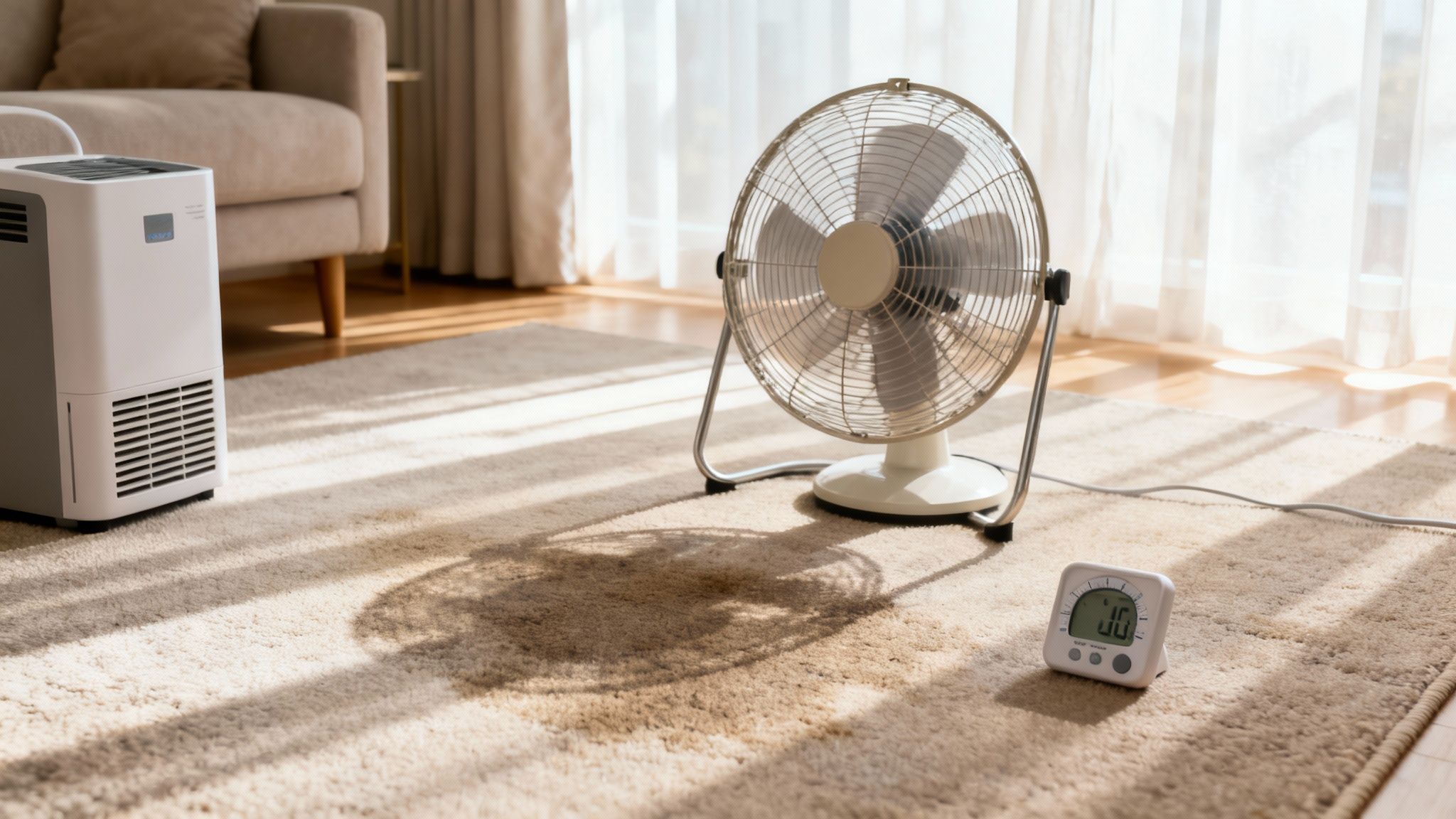
This is where a dehumidifier becomes your most valuable player. A good quality dehumidifier works tirelessly to pull moisture directly out of the air, creating the dry conditions needed for your carpet to release its own trapped dampness. It's a game-changer, particularly on those grey, drizzly Melbourne days when opening a window might actually let more moisture in than out.
A hygrometer, a small and inexpensive device, can help you monitor the room’s humidity levels accurately, taking all the guesswork out of the process.
Post-extreme weather like Townsville's 2025 events and Melbourne's rainy seasons, controlling indoor humidity below 60%—ideally 30-50%—slashes carpet mould risk by preventing spore germination on organic fibres, as mould requires moisture above this threshold. Eradicating damp and mould could cut health spending by A$117 million per million people annually. You can discover more about preventing mould after wet weather events and its significant impact.
Maximising Airflow for Faster Drying
A dehumidifier works best when it has some help. Using fans strategically is crucial for accelerating the drying time and preventing those musty smells from setting in. Stagnant, damp air is mould's best friend, so you need to keep it moving.
Here’s how to create an effective drying setup:
- Position Your Fans: Don't just point one fan at the wet spot. Place several fans at different angles to create a vortex of circulating air across the entire surface of the carpet.
- Elevate the Carpet: If possible, carefully lift the edge of the carpet and prop it up on something stable, like a few books. This allows air to circulate underneath, drying the backing and underlay at the same time.
- Use Heaters Cautiously: A small fan heater can help speed things up, but use it with care. Don't place it too close to the carpet, as excessive heat can damage synthetic fibres or even pose a fire risk. The goal is gentle, consistent warmth, not intense heat.
Combine these tools—a dehumidifier, fans, and a hygrometer—and you create a powerful system that actively pulls moisture out of your carpet and whisks it away. This multi-pronged attack is far more effective than any single method on its own. It's the difference between waiting days for a carpet to dry and getting it done in a matter of hours.
The Professional Advantage: Hot Water Extraction
While a DIY approach can work for small, surface-level issues, it has one major limitation: you can only remove so much moisture. After scrubbing and blotting, a significant amount of water stays locked deep within the carpet pile and, more critically, in the underlay. This is where professional hot water extraction, often called steam cleaning, shows its true value.
A professional truck-mounted system does two things that are nearly impossible to replicate with rented equipment.
- It injects hot water and a cleaning solution at high pressure, dislodging deep-seated dirt, mould spores, and contaminants.
- It immediately extracts that water with an incredibly powerful vacuum, pulling moisture out from the very base of the carpet and underlay.
The result is a carpet that isn't just clean on the surface but is left significantly drier than any DIY method could achieve. This drastically shortens the final drying time and removes the hidden moisture that so often leads to mould's return. It's the most reliable way to ensure you've truly mastered the drying process.
Knowing When to Call a Professional Mold Removal Service
While tackling a small, manageable mould spot yourself can feel empowering, it’s absolutely critical to recognise when you’re out of your depth. Trying to clean a significant infestation without the right gear or know-how can not only fail but actually make things worse. You risk spreading spores throughout your home, creating an even bigger problem and a serious health hazard.
Knowing that tipping point between a minor cleanup and a major contamination issue is key to protecting your family and your property.
The Clear Signs You Need an Expert
Some situations are non-negotiable red flags. They’re clear signals that the mould has gone far deeper than the surface fibres, making it impossible to get rid of with household methods alone. If you spot any of these, don't hesitate—it's time to call in the professionals.
Here’s what to watch out for:
- The mould covers more than one square metre: This is the industry benchmark for a serious problem. An area this large points to a major moisture source and a well-established colony that has almost certainly spread into the carpet backing, underlay, and possibly even the subfloor.
- The mould keeps coming back: You’ve scrubbed and treated the area, only for that same discoloured patch or musty smell to reappear a few weeks later. This frustrating cycle means you’re only cleaning the surface. The roots of the problem are still thriving deep within the carpet’s structure.
- Your family is experiencing symptoms: Are people in your house suddenly dealing with persistent coughs, sneezing, itchy eyes, or worsening asthma? Your indoor air quality is likely compromised. Airborne mould spores are a very common trigger for these kinds of allergic reactions.
- The carpet was saturated by a flood or leak: If your carpet was soaked from a burst pipe, a faulty appliance, or flooding and wasn't professionally dried within 24-48 hours, you have to assume mould has taken hold in the underlay.
That last point is especially important. Porous materials like carpet backing and underlay are like sponges. They trap moisture and create the perfect hidden breeding ground for mould to flourish completely unseen.
What Professionals Bring to the Fight
Calling a professional service like Right Price Carpet Cleaning isn’t just about convenience; it’s about bringing in a level of technology and expertise that the average homeowner simply doesn't have. Our trained technicians don't just show up and start scrubbing. They arrive with a strategic plan and industrial-grade equipment designed to solve the problem for good.
This isn’t just a surface clean. A professional service tackles the entire mould ecosystem—from the spores you can see to the hidden moisture deep within your flooring. It’s the only way to ensure a truly healthy living environment.
A 2022 survey revealed a startling reality for many Australians. It found that a staggering 50% of respondents had experienced mould or dampness in their homes in the last year, with carpets being a prime culprit. While DIY solutions like vinegar are often recommended, they're really only effective on hard, non-porous surfaces—not carpets, where spores can hide deep within the fibres. You can learn more about Asthma Australia’s findings on mould health hazards.
DIY vs Professional Mold Removal at a Glance
Deciding whether to tackle mould yourself or bring in the experts can be tough. This table breaks down what you can expect from each approach, helping you make the right call for your home and family.
| Factor | DIY Approach | Right Price Professional Service |
|---|---|---|
| Equipment | Household cleaners, spray bottles, scrubbing brushes. | Truck-mounted hot water extraction machines, industrial air movers, commercial-grade dehumidifiers. |
| Treatment | Surface-level cleaning with vinegar or store-bought products. | Specialised anti-microbial treatments that kill mould at the root, followed by deep steam cleaning to remove all residue. |
| Expertise | Relies on general knowledge and online guides. | IICRC-certified technicians trained in mould remediation, moisture detection, and safe spore containment. |
| Results | Often temporary, with a high risk of mould returning. | A complete and permanent solution with a 100% satisfaction guarantee, ensuring the mould is gone for good. |
Ultimately, calling a professional is an investment in certainty. It gives you the peace of mind that the job is done right, protecting your home's value and—most importantly—your family’s health from the hidden dangers of carpet mould.
Got a Few More Questions About Carpet Mould?
It's completely normal to still have a few questions floating around, even after getting the lowdown on how to tackle mould. When you're dealing with something as stubborn as carpet mould, you want to be sure you've covered all your bases. We get asked the same things by Melbourne homeowners all the time, so we’ve put them all in one place to clear things up.
Think of it as a final sanity check before you dive in.
Can a Mouldy Carpet Actually Be Saved?
This is the big one, and the honest answer is: it really depends on how bad the damage is. If you've caught a small patch of surface mould early on, and the carpet backing and underlay are still dry and in good shape, then yes—you've got a great shot at saving it with a proper clean.
But if the carpet was soaked from a serious leak or flood and wasn't professionally dried within 24-48 hours, the outlook isn't so good. Once mould sinks its roots deep into the porous backing and underlay, it’s next to impossible to get it all out. In those cases, replacing the carpet is almost always the safest and most reliable long-term fix.
Here's a good rule of thumb: Mould from a small spill that you cleaned up quickly is usually salvageable. Mould from a slow, hidden leak that has drenched the underlay means it’s time to say goodbye to the carpet to protect your health and your subfloor.
Is It Safe to Sleep in a Room with Carpet Mould?
We would strongly advise against it. Sleeping in a room with mould, no matter how small the patch seems, means you're breathing in microscopic spores all night long. For anyone, this can be an irritant, but for people with asthma, allergies, or a weakened immune system, it can be downright dangerous.
Spending that much time exposed to mould can lead to a whole range of health problems, including:
- Worsening asthma or other respiratory conditions.
- A nagging cough, constant sneezing, or sinus issues.
- Skin rashes and irritation.
- Headaches and a feeling of being tired all the time.
Your bedroom should be a healthy space. It's much better to find somewhere else to sleep until the mould has been completely and professionally removed.
Why Did the Mould Come Back After I Cleaned It?
This is a classic—and incredibly frustrating—problem with DIY mould removal. If you've cleaned mould and it just reappears, it almost always comes down to one of two things.
First, the original moisture problem was never actually fixed. Maybe there's still a tiny, slow leak in a pipe somewhere, condensation building up on a window, or the room is just too humid. If the dampness comes back, the mould will too.
Second, the cleaning just didn't go deep enough. Surface cleaners like bleach or a light spray of vinegar might kill what you can see on the carpet fibres, but they often don't reach the "roots" of the mould growing in the backing and underlay. If you don't kill the entire colony, it's guaranteed to grow back.
What’s Wrong with Using Bleach on Carpet Mould?
So many people reach for the bleach bottle thinking it’s the ultimate mould killer, but for carpets, it’s one of the worst choices you can make. Bleach is an aggressive chemical that can easily strip the colour right out of your carpet, leaving you with a permanent, bleached-out spot.
Even worse, bleach isn't actually that effective on porous materials like carpet. Its chemical makeup stops it from soaking deep into the backing to kill the mould at its source. So, while it might look clean on the surface for a little while, you've left the root of the problem behind, just waiting to grow back. You’re much better off with solutions like white vinegar, which can penetrate deeper without wrecking your carpet’s colour.
Still have questions or feel like your mould problem is a job for the experts? The team at Right Price Carpet Cleaning has the professional equipment and certified expertise to permanently get rid of carpet mould. For a guaranteed solution and peace of mind, get your instant online quote today.
Recent Comments