



Your patio looked fine last summer. Then Melbourne winter did what it does. Damp mornings, tracked-in mud, a bit of moss in the shaded corner, and now the driveway has that dark film that makes the whole front of the house feel tired.
A common first approach is to reach for the garden hose. They scrub, rinse, step back, and realise the surface is still dull. That is usually the moment cleaning with high pressure water starts to make sense. Used properly, it can strip away built-up grime fast and reveal the original surface underneath. Used badly, it can scar timber, shred paint, force water where it should not go, or injure the person holding the wand.
That gap between “satisfying clean” and “expensive mistake” is all about method. Not just pressure. Method.
A Melbourne homeowner needs more than a generic guide. Local conditions matter. Wet winters encourage algae and mildew on outdoor hard surfaces. Water restrictions and runoff concerns matter too. And indoors, the wrong machine can ruin fibres that should have been steam cleaned instead.
The Ultimate Guide to High Pressure Water Cleaning
A common callout in Melbourne goes like this. The concrete path has gone black in patches. The pavers are slippery near the clothesline. The timber fence has that grey, weathered look that makes the yard feel older than it is. None of these problems look dramatic at first, but together they drag down the whole property.
High pressure water cleaning works because it focuses water into a far more forceful stream than a hose. That concentrated force lifts dirt, algae, mud, and surface grime off hard materials that can handle it. On the right surface, the change is immediate. Concrete brightens. Brick regains colour. Pavers stop looking permanently stained.
Why homeowners get mixed results
The machine is only part of the story. The result also depends on:
- Surface type: Concrete and stone behave very differently from painted timber or carpet.
- Spray angle: A wide fan can clean gently. A narrow jet can cut into a surface.
- Distance: Too close and you can etch or gouge. Too far and you waste time.
- Water control: Runoff, detergents, and dirty wash water need thought before you start.
Tip: If a surface is valuable, old, painted, polished, or soft, pause before you wash. The safest cleaning method is often not the most aggressive one.
Why this matters in Melbourne
Outdoor cleaning here is not just about appearances. Moss on paving can become a slip hazard. Mud and grime after storms can cling to porous surfaces. Flood recovery has also pushed pressure washing into the spotlight. In Victoria, demand for professional pressure washing surged by 25% post-2022 floods for restoring flood-damaged surfaces, and it remains a common method for high-traffic homes and end-of-lease cleaning, according to this industry overview on pressure washing in Australia.
The smart approach is simple. Match the tool to the surface. Use high pressure water outdoors where it belongs. Use gentler methods where it does not.
Understanding How Pressure Washers Work
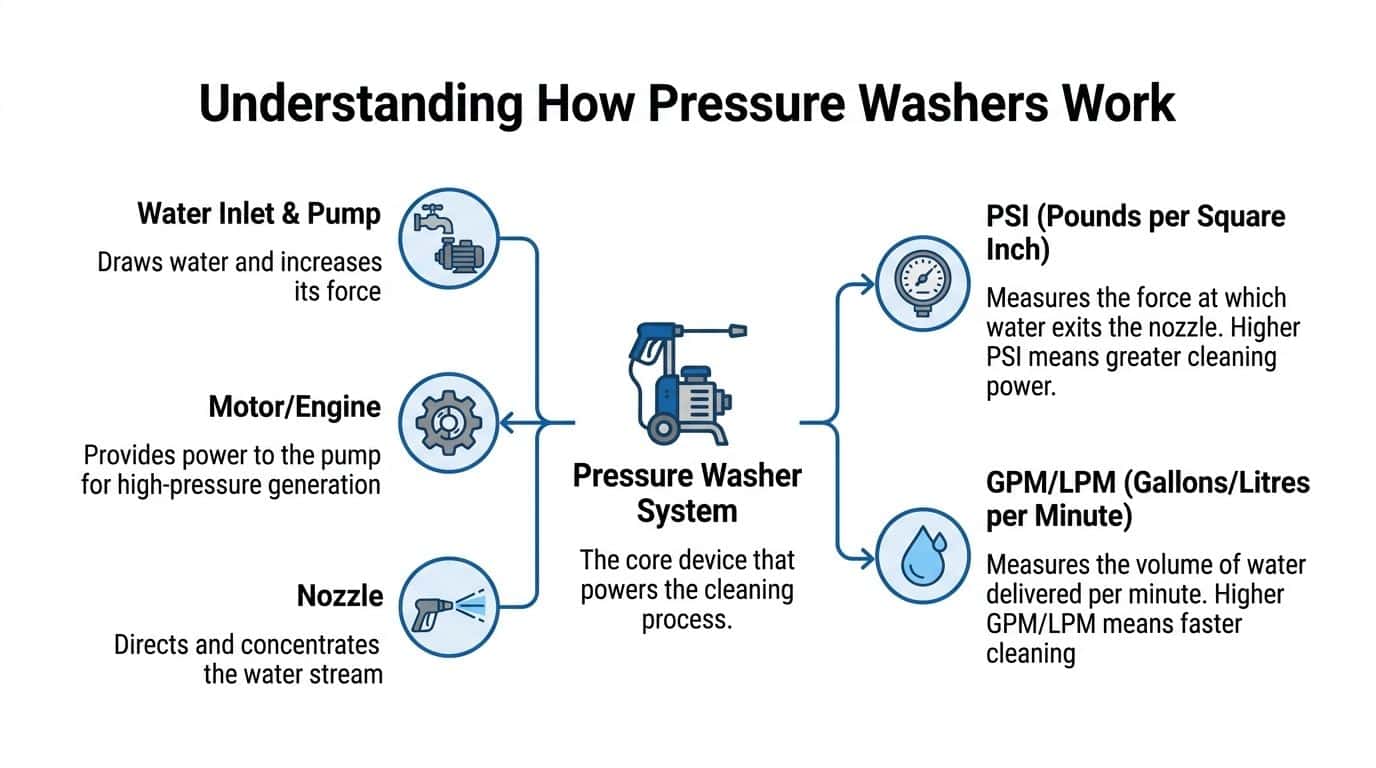
Pressure washers sound technical, but the basics are easy once you separate the two jobs the machine does. One part creates force. The other part delivers water volume.
PSI is force and GPM is rinsing power
Think of PSI as the punch. It tells you how hard the water hits the surface.
Think of GPM or LPM as the rinse. It tells you how much water is moving across the area to carry dirt away.
A lot of homeowners focus only on pressure. That is where confusion starts. A machine can hit hard but still clean slowly if it does not move enough water. The best results come from balance.
For Australian water use, professional pressure washers commonly use 3 to 5 gallons per minute, about 11 to 19 litres per minute, while a standard garden hose uses 8 to 12 gallons per minute, about 30 to 45 litres per minute, which can mean up to 60 to 70% less water usage for the same cleaning task when pressure washing is done properly, as outlined in this breakdown of pressure washing water use in Australia.
What the pump and nozzle do
The machine pulls in ordinary water. The pump compresses that flow so the water exits with force. The motor or engine powers the pump. The wand and nozzle shape the spray.
That last part matters most in day-to-day use. The nozzle changes the stream from a very narrow jet to a broad fan. Wider is usually safer. Narrower is more aggressive.
Here is the practical version:
- 0-degree nozzle: Very tight stream. This is the most likely to mark or cut a surface.
- 15-degree nozzle: Strong fan for stubborn grime on durable outdoor materials.
- 25-degree nozzle: A common general-purpose choice for many hard surfaces.
- 40-degree nozzle: Wider, gentler spray for lighter cleaning and rinsing.
- Soap nozzle: Low-pressure application for detergent, not for blasting dirt away.
Why nozzle choice changes everything
A kitchen knife and a butter knife can both touch the same surface. One spreads, one cuts. Nozzles work in a similar way.
A tight stream concentrates force into a small point. A fan nozzle spreads that force over a wider area. That is why two people can use the same machine and get very different outcomes. One person cleans. The other leaves zebra stripes in timber decking.
Key takeaway: For most household jobs, start with the widest practical fan nozzle and more distance than you think you need. You can always move closer or adjust upward.
If you keep that principle in mind, cleaning with high pressure water becomes far less mysterious and much safer.
Ideal Surfaces for a Powerful Clean
The best jobs for pressure washing are sturdy outdoor surfaces that collect grime in layers. You see them every day, then one proper clean makes you wonder how you tolerated the mess for so long.
Concrete and paved areas
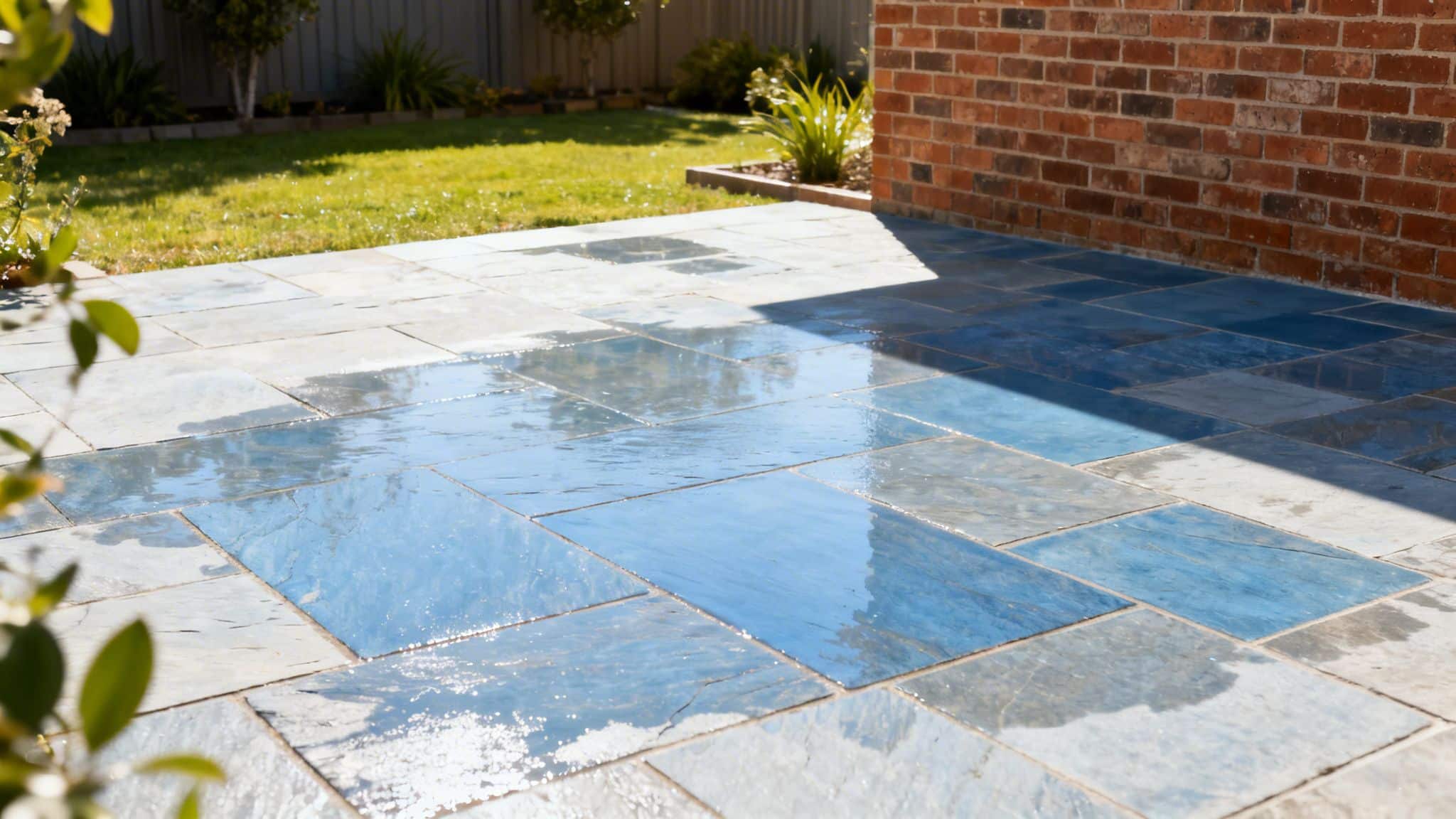
Driveways, footpaths, and solid concrete pads are classic pressure washing jobs. These surfaces trap tyre marks, fine dirt, leaf tannins, and algae. Because they are hard and non-fibrous, they generally tolerate a strong wash better than softer materials.
For homeowners dealing with stained outdoor slabs, this guide to power washing concrete is a useful reference point for what good preparation and technique look like.
A bluestone or paver patio can also come up beautifully, especially after a damp season. Pressure washing clears grime from the surface texture and joints, which is one reason it is so popular for end-of-lease clean-ups and heavily used outdoor areas.
Brick walls and exterior masonry
Brick and masonry hold up well when they are in sound condition. They respond well because dirt tends to sit on the surface rather than soak into fibres the way it does with carpet or upholstery. Homeowners often get that “new again” result here. A brick courtyard that looked permanently dark can brighten quickly once built-up residue lifts off.
Timber fences and decks with caution
Some exterior timber can be cleaned with high pressure water, but this is the point where confidence needs to be matched with restraint. Sound hardwood fencing or decking may handle a careful wash before resealing or staining. Soft or weathered timber is a different story.
The aim is not to blast wood back to raw pale fibres. The aim is to remove surface dirt and prep it evenly. If the grain starts to fuzz, you are already too aggressive.
Flood-affected hard surfaces
After storm or flood events, pressure washing becomes more than cosmetic. In Victoria, demand for professional pressure washing surged by 25% post-2022 floods for restoring flood-damaged surfaces, according to the same earlier industry overview. Mud, residue, and contaminants cling to concrete, masonry, and outdoor tiled areas in ways a standard hose struggles to remove.
Good candidates at a glance
| Surface | Why it works well |
|---|---|
| Concrete driveway | Hard, durable, and prone to surface grime |
| Brick patio | Handles outdoor washing well when mortar is sound |
| Pavers | Good for removing algae and dirt from textured surfaces |
| Exterior masonry walls | Surface grime lifts effectively from solid materials |
| Some timber fencing | Can be suitable if timber is sound and pressure is controlled |
Tip: If the surface is hard, outdoor, and designed to face weather, pressure washing is often a strong option. If it is decorative, delicate, or absorbent, slow down and reassess.
Surfaces to Avoid and Common Mistakes
The biggest mistake homeowners make is assuming every dirty surface wants the same answer. It does not. Some materials need force. Others need patience.
The trouble is that many guides stay vague. There is no established regional guidance on safe pressure ranges for Australian-specific materials, including local hardwoods that react to humidity swings, or clear distinctions between pressure washing and steam cleaning for different fibre types, as noted in this discussion of pressure-safe surface guidance gaps.
The red-light surfaces
Some surfaces should make you stop immediately.
- Carpets and rugs: High pressure water drives dirt deeper, overwets backing, and can distort fibres. For wool in particular, use a fibre-safe method instead. This guide on how to clean wool carpet explains why gentler, controlled cleaning matters.
- Upholstery: Fabric, stitching, padding, and internal cushioning are not designed for outdoor blasting.
- Painted surfaces: Pressure can strip paint faster than expected, especially on weathered trim and fences.
- Older brick and weak mortar: The brick might survive. The mortar joints may not.
- Asphalt roofs and fragile roofing materials: Water can force its way under edges and damage the surface.
- Soft timber: The grain can lift, splinter, or fur up.
Common mistakes that cause damage
The machine does not need to be faulty for things to go wrong. User habits are the usual problem.
Getting too close
Distance changes impact dramatically. If you hold the nozzle too near the surface, the spray stops cleaning and starts cutting. This is how people leave lines in decking and pockmarks in render.
Using the wrong nozzle
A narrow nozzle on a delicate surface is like using a chisel when you meant to use a sponge. Many DIY users reach for the most aggressive setting because it feels efficient. It often creates more repair work than cleaning progress.
Washing indoors
Pressure washers belong outside. Indoor floors, tiles near grout lines, carpets, mattresses, and lounges need controlled water, extraction, and dry-time management. Spraying a lounge suite or bedroom carpet with outdoor equipment is not a shortcut. It is a recovery job waiting to happen.
Pressure Washing Suitability Cheat Sheet
| Surface | Suitability | Reason |
|---|---|---|
| Concrete driveway | Good | Durable outdoor hard surface |
| Brick pavers | Good | Handles grime removal well if joints are sound |
| Sound masonry wall | Good | Suitable for surface dirt and algae removal |
| Painted fence | Caution | Paint can lift or peel |
| Soft timber deck | Caution | Grain can fuzz or gouge |
| Older mortar joints | Avoid or extreme caution | Pressure can erode weakened joints |
| Carpet or rug | Avoid | Fibres and backing can be damaged |
| Upholstery | Avoid | Overwetting and fabric damage risk |
| Asphalt-style roofing | Avoid | Surface and water-ingress risk |
Rule of thumb: If damage would be expensive, visible, or difficult to dry, pressure washing is rarely the first tool to reach for.
Your Guide to Safe and Eco-Friendly Cleaning
A pressure washer is not just a stronger hose. It is a tool that can injure people and move contaminated water into places it should never go. Good cleaning starts before the trigger is pulled.
Safety first on every job
Safe Work Australia states that trained operators are needed to manage high-pressure water jetting hazards, including injection injuries, and that using the nozzle at less than 30 cm increases laceration risk by 300%, according to the Safe Work Australia guide to managing high-pressure water jetting.
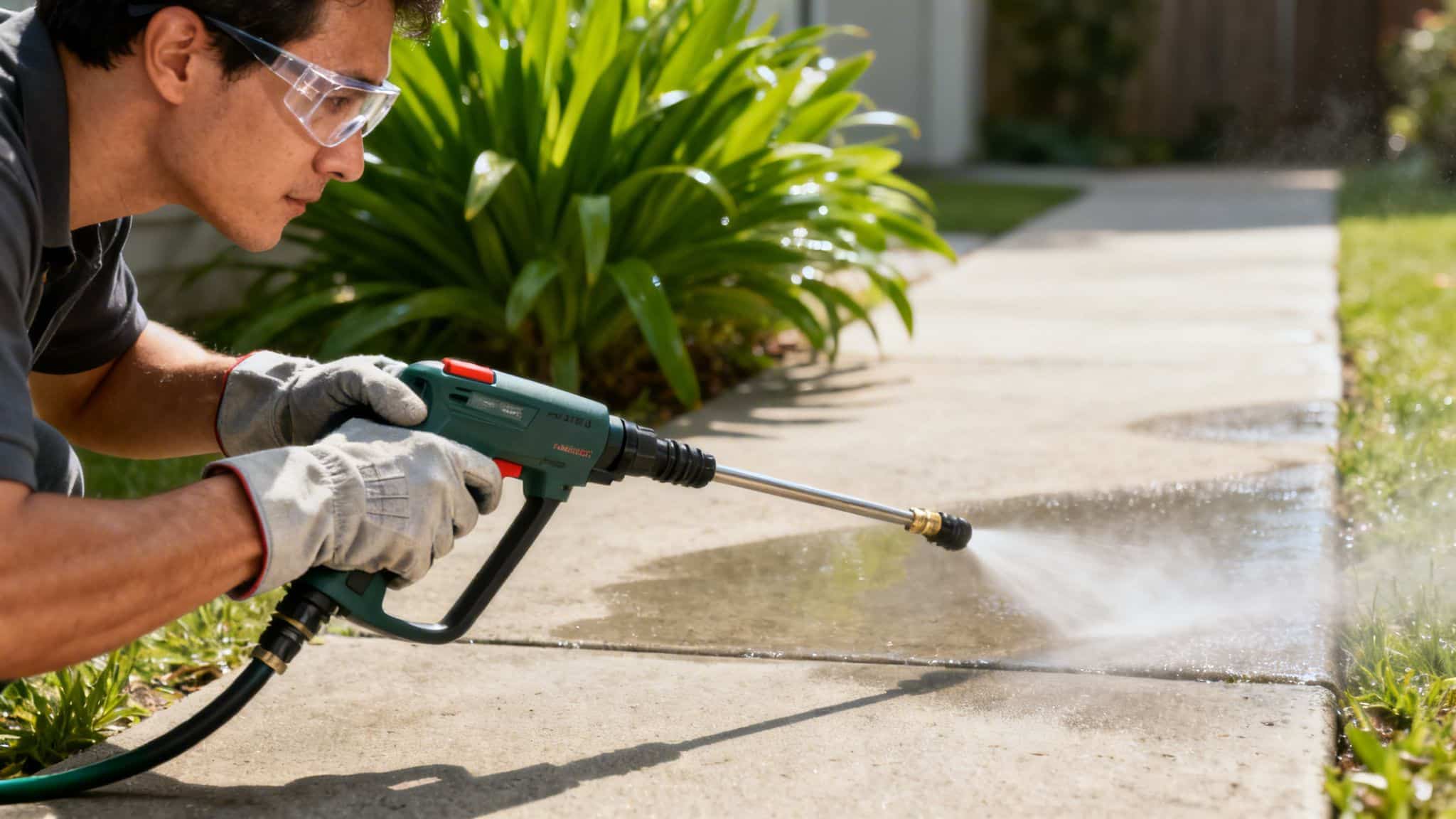
That sounds industrial, but the lesson applies at home too. Distance matters. Control matters. So does basic protective gear.
Use:
- Safety glasses: Grit and chipped debris can bounce back fast.
- Gloves: They improve grip and protect your hands from spray and rough surfaces.
- Sturdy enclosed footwear: Wet concrete and algae-covered pavers get slippery quickly.
- Stable footing: Never work from an unstable ladder with a live wand.
If you are unsure about glass, frames, seals, or upper-storey access, this guide on whether you can pressure wash windows safely is worth reading before you start. Windows are one of the easiest places to turn a cleaning job into water ingress or cracked seals.
Cleaner does not have to mean wasteful
One of the better surprises with cleaning with high pressure water is that it can be more water-efficient than old-fashioned hose cleaning. Professional pressure washers commonly use 3 to 5 gallons per minute, while a standard garden hose uses 8 to 12 gallons per minute, which is why pressure washing can use up to 60 to 70% less water for the same task when used correctly, as noted earlier in the water-use source.
That matters in Australia. During the Millennium Drought, Melbourne’s reservoir levels dropped to 25.6% in 2009 in the context of prolonged water restrictions, according to the same earlier source.
Keep dirty runoff out of stormwater
A clean patio should not mean a dirty storm drain. Before washing:
- Sweep first: Remove leaves, loose soil, and rubbish so they do not turn into slurry.
- Plan the runoff path: Avoid pushing dirty water straight toward gutters and stormwater grates.
- Use detergents carefully: If you use any product, choose one suited to the task and prevent runoff where possible.
- Contain messier jobs: Oil, paint flakes, animal waste, or flood residue should not be rinsed into the street.
Key takeaway: Responsible pressure washing means protecting both the surface in front of you and the drainage system around it.
Effective Alternatives for Indoor and Delicate Surfaces
Some surfaces need cleaning power without blunt force. That is where alternatives matter.
Soft washing for gentle exteriors
For delicate outdoor areas such as painted render, weathered timber, or surfaces with fragile finishes, soft washing is often the better choice. The idea is simple. Use lower pressure, more dwell time, and the right cleaning solution rather than trying to blast contamination away.
This is especially useful where the risk of etching, splintering, or forcing water behind a surface is high.
Steam cleaning for indoor surfaces
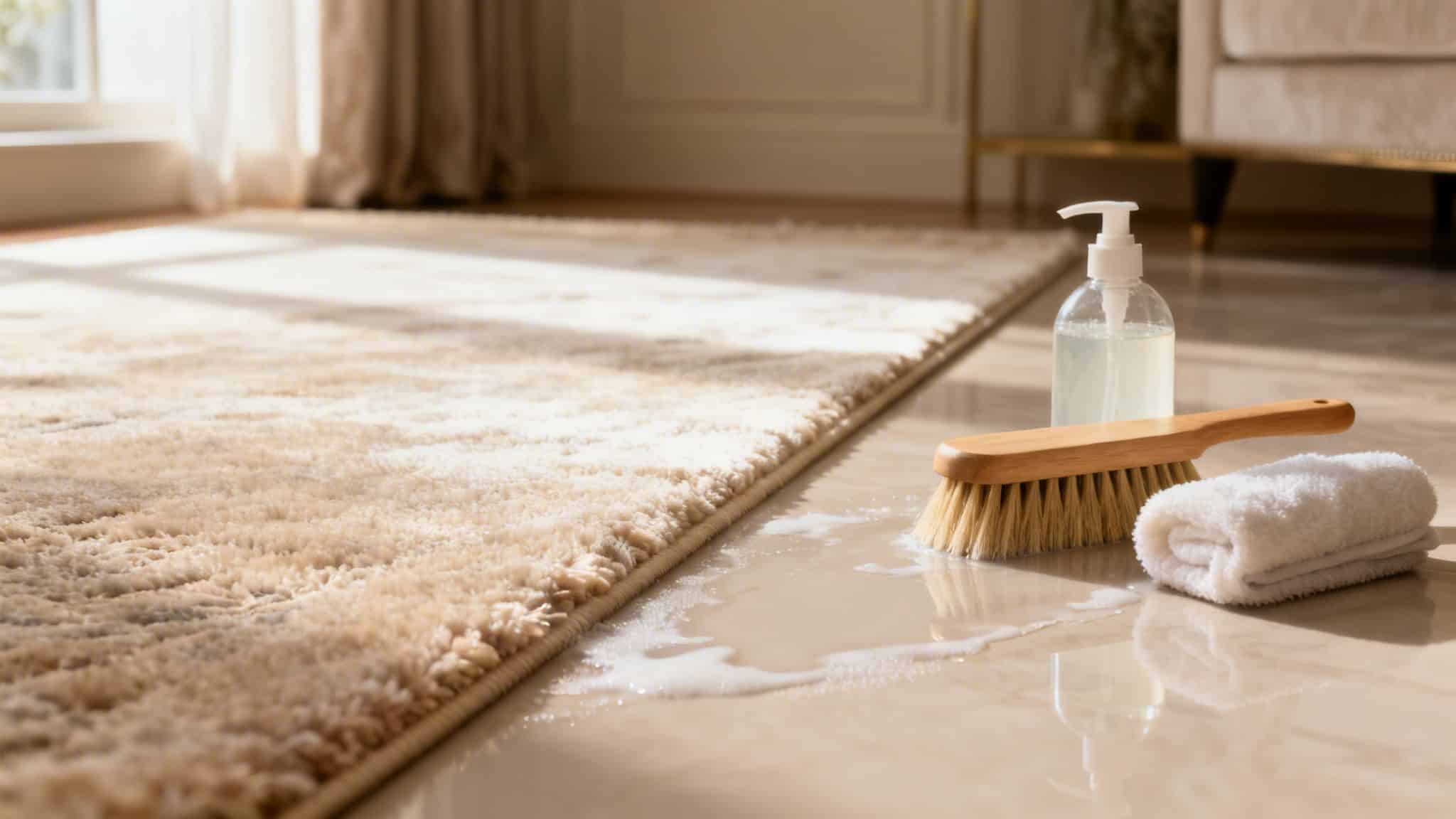
Indoors, the right answer is usually not pressure washing at all. Carpets, rugs, upholstery, mattresses, and many indoor tiled areas need controlled application and strong extraction.
That is why professional steam cleaning, often called hot water extraction, is the preferred method for many interior materials. It loosens soil with heat and cleaning agents, then extracts suspended dirt and moisture rather than driving water violently into the surface.
For tiled interiors, grout lines and soil build-up need a method designed for enclosed spaces, not an outdoor spray wand. If you are comparing options for hard flooring inside the home, this guide to cleaning tile and grout floors is a useful place to start.
Why indoor cleaning needs a different mindset
Advanced ultra-high-pressure water technology can reduce water consumption by 50% and recover up to 95% of wastewater, but even with those efficiencies, steam cleaning remains the more suitable and water-efficient option for indoor surfaces compared with any high-pressure method, based on this overview of ultra-high-pressure water technology.
That distinction is important. Efficient outdoor technology does not automatically make it appropriate for lounge rooms, bedrooms, or fabric furnishings.
A quick comparison helps:
| Method | Best for | Not ideal for |
|---|---|---|
| High pressure water | Concrete, brick, pavers, outdoor masonry | Carpets, upholstery, delicate finishes |
| Soft washing | Delicate exteriors, painted surfaces, sensitive timber | Heavy hard-surface grime that needs stronger mechanical force |
| Steam cleaning | Carpets, rugs, upholstery, indoor tile and grout | Large outdoor concrete cleaning jobs |
Practical rule: Outdoor hard surfaces usually benefit from pressure. Indoor fibres and furnishings usually benefit from extraction.
DIY or Hire a Pro in Melbourne?
DIY can work well when the job is small, the surface is clearly suitable, and you have room to practise without risking expensive damage. A basic concrete path or a small paved area is very different from a painted weatherboard wall, a second-storey exterior, or a flood-affected surface with contamination concerns.
When DIY makes sense
DIY is usually reasonable if:
- The surface is sturdy: Think plain concrete, solid pavers, or sound masonry.
- The area is easy to access: No ladders, awkward slopes, or tight corners near glass and doors.
- You can test first: A hidden patch gives you a chance to check pressure, distance, and nozzle choice.
- You know when to stop: If the surface reacts badly, you switch methods instead of pushing on.
When a professional is the safer call
As of 2023, Australia has over 6,500 pressure cleaning businesses, and for Melbourne homeowners the important thing is choosing a qualified, insured, and experienced technician to reduce the risk of surface damage and get a reliable finish, based on the earlier industry source.
Call a pro when the job involves height, delicate materials, unknown staining, or post-storm mess. Also call a specialist if the problem is not really a pressure-washing job at all. A patio that drains poorly, for example, may keep growing algae until the drainage issue is fixed. If water is backing up around outdoor areas, these practical blocked drain solutions can help you identify whether the underlying problem starts underground.
The simplest decision rule
Use pressure washing for the right outdoor hard surfaces. Use steam cleaning for indoor soft furnishings and most interior floor care. Hire expertise when the surface is valuable, the risk is high, or the cause of the mess is not obvious.
For carpets, rugs, upholstery, and indoor tile and grout, the specialist route is the sensible one.
If you need a professional clean for carpets, rugs, upholstery, mattresses, or tile and grout across Melbourne, Right Price Carpet Cleaning offers truck-mounted steam cleaning, straightforward pricing, and customized service for homes, rentals, offices, and high-traffic spaces.
Recent Comments