



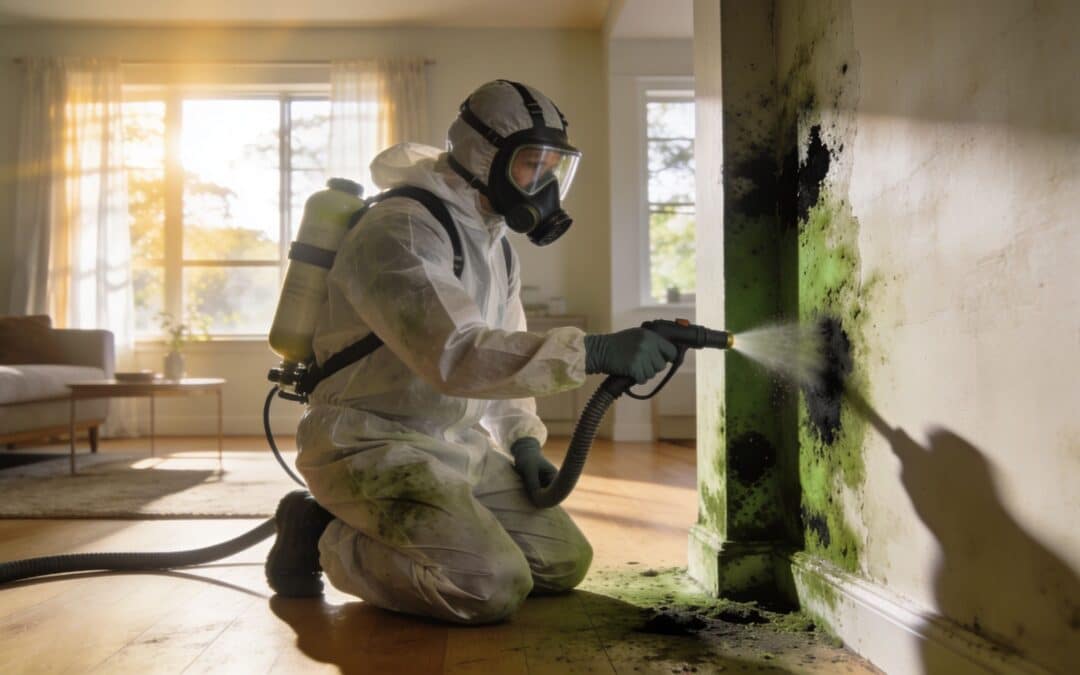
You notice it after a run of damp Melbourne days. The windows are beading up in the morning, the spare room smells stale, and when you pull the couch a little forward to vacuum, there it is. A dark patch on the skirting. Maybe a fuzzy bloom near the carpet edge. Maybe the room just never feels fresh, no matter how often you open the windows.
That moment unsettles people for good reason. Mould never feels contained to one mark on one surface. It raises bigger questions straight away. Is it in the wall? Has it spread under the carpet? Is it affecting the kids, the dog, your breathing, your furniture? If you’ve already wiped it once and it came back, the stress climbs fast.
In Melbourne homes, that pattern is common. A leak, poor airflow, winter condensation, an unnoticed spill, a bathroom fan that doesn’t quite do its job. Then the musty smell settles in and starts telling you there’s more going on than what you can see.
That Musty Smell The Moment You Know You Have a Mould Problem
A musty odour usually arrives before the full visual mess does. Homeowners often tell me the same thing. They first thought it was old carpet, damp washing, or a room that had been shut up too long. Then they found spotting behind a bedhead, under curtains, along a wardrobe wall, or around the edge of a rug where airflow had been blocked for weeks.

That’s why mold professional removal shouldn’t be seen as a dramatic overreaction. In many homes, it’s the point where guesswork stops. A proper inspection tells you whether you’re dealing with a surface issue, a moisture problem inside building materials, or contamination that has settled into soft furnishings as well.
What people usually notice first
The early signs are often ordinary enough to dismiss:
- A stubborn smell: The room smells earthy or damp even after airing out.
- Recurring marks: You wipe down a patch, then it comes back in the same area.
- Condensation patterns: Windows fog up often, especially in bedrooms and closed living spaces.
- Soft furnishing clues: Rugs, carpet edges, curtains, and upholstered furniture start holding odours.
When there’s a leak involved, the mould issue is rarely the first failure in the chain. The moisture source needs attention as much as the cleanup does. If you suspect the problem started with water ingress, guidance on preventing structural damage from leaks can help you think beyond the visible patch and focus on the building issue that fed it.
Most homeowners don’t call because they saw one spot. They call because the home stopped smelling clean.
If the smell is your main clue, it helps to understand how odours linger in fabrics and underlay as well as on walls. A practical guide to getting rid of a musty smell in the house can help you tell the difference between stale air and a genuine contamination problem.
More property owners are taking that step. The global mold remediation service market was valued at USD 1,234.6 million in 2023 and is projected to reach USD 1,516.8 million by 2030, growing at a CAGR of 3.0%, according to Grand View Research’s mold remediation service market report. That growth reflects something homeowners already know firsthand. Mould isn’t just cosmetic, and peace of mind matters when your living space starts feeling unhealthy.
When to Call a Professional The Health Risks and Warning Signs
Not every spot of mould needs a full remediation crew. But some situations do. The difference comes down to what caused it, where it’s growing, whether it keeps returning, and who lives in the home.
Melbourne’s climate complicates the picture. Humidity often exceeds 60 to 70 per cent, and mould spores can colonise porous surfaces like carpet within 24 to 48 hours. Untreated carpets in Victorian homes can harbour up to 1 million spores per square metre, affecting indoor air quality and exacerbating respiratory issues in an estimated 15 per cent of Melbourne households, as noted in this mould remediation process guide. That’s why a patch on the wall and a smell in the carpet often belong to the same problem.
The health risk isn’t just the visible patch
Think of spores like very fine dust. Once mould is active, movement in the room can disturb it. Walking across carpet, pulling curtains, shifting furniture, or running a fan can move contaminants through the air and onto other surfaces.
For some households, that’s more than an irritation. It can make a home feel stuffy, aggravate allergy-type symptoms, and keep a room from ever feeling clean. The concern rises when someone in the property already has asthma, other respiratory sensitivity, or is struggling with an immune-related health issue.
A visible stain is only one part of the assessment. The more important question is whether there’s an ongoing moisture source and whether porous materials have been affected.
Signs that push this into professional territory
Call a professional when one or more of these are true:
- The mould keeps coming back: If you’ve cleaned it before and it reappears, you haven’t solved the moisture problem or the contamination has spread beyond the surface.
- Carpet, underlay, or upholstery smells affected: Soft materials trap moisture and spores far more easily than painted plaster.
- The mould followed a leak or flood: Water events change the risk level because moisture often travels farther than the visible staining.
- The affected area is broad or scattered: Multiple rooms, repeated patches, or growth in hidden corners usually point to a wider issue.
- Someone in the home is reacting to the space: If symptoms seem worse indoors, it’s sensible to stop experimenting with household cleaners and get the environment assessed.
Practical rule: If the mould is tied to water intrusion, repeat growth, or soft furnishings, treat it as a building and indoor air problem, not a wiping job.
What DIY gets wrong
DIY treatment usually focuses on what’s easy to see. People spray the wall, scrub the skirting, maybe run a supermarket dehumidifier for a few days, then assume they’re done. Sometimes that works for very minor condensation spotting. Often it doesn’t.
The failure points are predictable:
- The moisture source stays active. A slow leak, poor bathroom extraction, or blocked airflow keeps feeding regrowth.
- The wrong materials get “cleaned” instead of removed. Some porous items can’t be restored if contamination is too deep.
- Spores get spread during cleanup. Dry brushing, aggressive vacuuming, or ripping up affected material without containment can make a local issue bigger.
A common example in Melbourne is the back bedroom where the bed sits hard against an external wall. The owner sees mould on the plaster and assumes that’s the whole problem. But the carpet edge, bed base, curtain hem, and even the back of the bedside table may all be holding contamination and moisture residue. Cleaning only the wall won’t reset the room.
The warning signs people ignore too long
Some indicators don’t look dramatic, but they matter:
- A wardrobe wall that feels cooler and smells stale
- Carpet that still smells damp after it has “dried”
- A lounge suite near a window that has picked up a sour odour
- Dark speckling behind furniture placed against outside walls
- Rooms that trigger coughing or congestion more than others
Those are the jobs where mold professional removal makes sense. Not because every home is in crisis, but because the correct response is controlled, methodical, and based on how mould behaves in real houses.
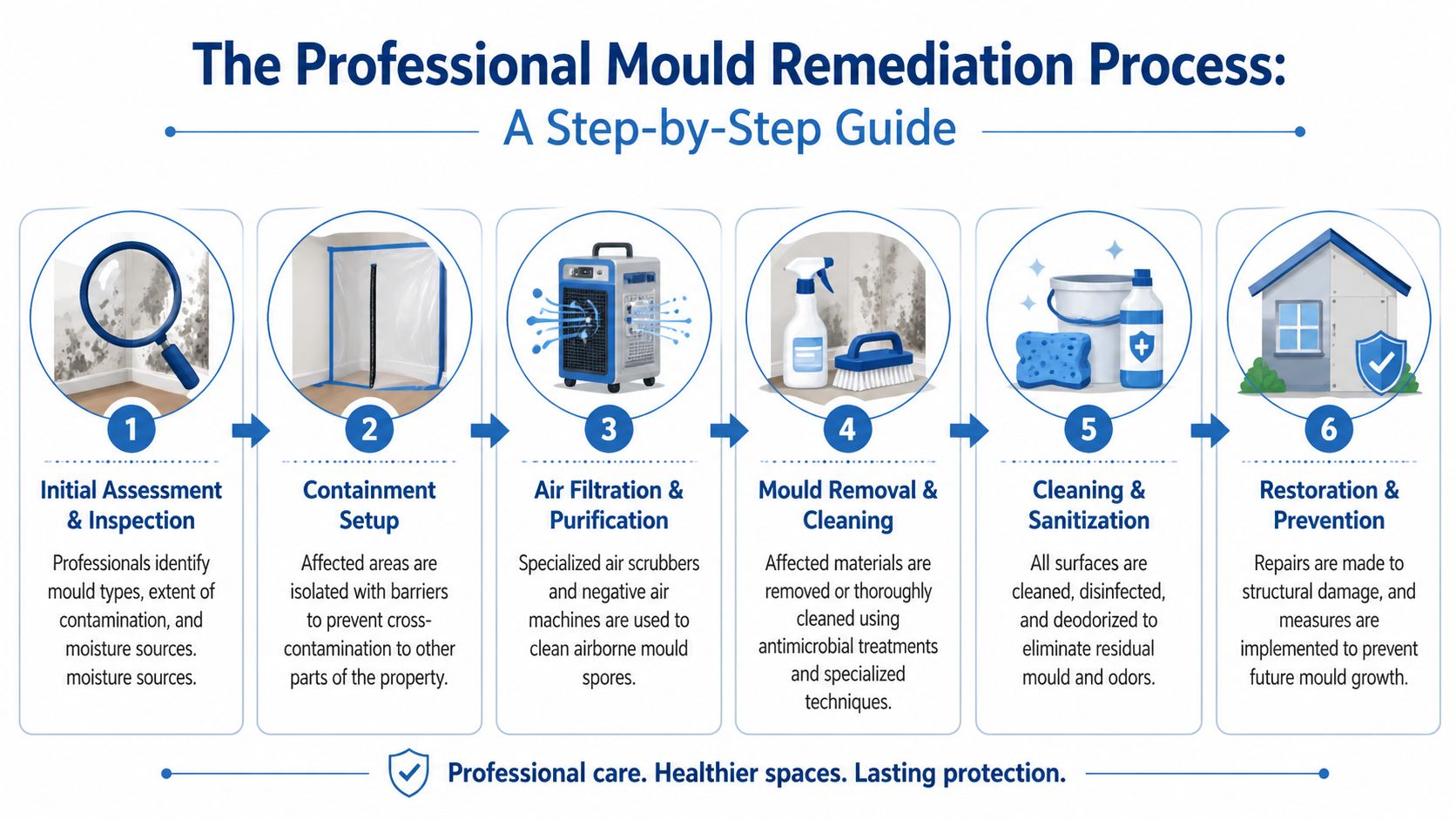
The Professional Mould Remediation Process Step by Step
Professional remediation operates much like a controlled clean-room job inside a lived-in house. The goal isn’t to attack mould aggressively and hope for the best. The goal is to stop spread, remove what can’t be saved, clean what can, and verify the area is dry and stable.
Inspection and scope
The first step is inspection. A technician looks for visible growth, but just as importantly, they look for the moisture source and the path it has taken. That includes checking where the damage started, which materials are porous, and whether the problem is localised or connected to other rooms.
Soft furnishings need to be considered properly. If mould started near an external wall or after a leak, carpet, underlay, rugs, and upholstered items in the area can’t be treated as an afterthought.
Containment changes everything
Containment is one of the clearest differences between a professional job and a failed DIY cleanup. WorkSafe Victoria-based professional containment uses 6-mil polyethylene sheeting and negative air machines to prevent cross-contamination. This approach is successful in 95 per cent of cases, compared with a 40 per cent DIY failure rate due to spore migration, according to CSIRO building pathology reports, as summarised in this step-by-step professional mould remediation guide.
Containment means isolating the affected zone before disturbing it. In practice, that can look like temporary plastic barriers, controlled access points, and airflow management that keeps contaminants from drifting into hallways, bedrooms, or return-air pathways.
If you remove mould without containment, you can turn one bad room into a whole-house cleanup problem.
Air filtration and controlled removal
Once the area is sealed, professionals use HEPA-filtered equipment and negative air machines to capture airborne particles while work is underway. That matters because physical disturbance is unavoidable. Cutting out damaged plaster, lifting carpet, removing underlay, or shifting contaminated items all release particles into the air.
The actual removal stage depends on the material.
- Non-porous surfaces can often be cleaned and treated.
- Porous materials may need to be removed if growth has permeated the material.
- Mixed-material rooms need sequencing, so cleanable items aren’t re-contaminated while demolition is still happening.
A competent team doesn’t rush this part. They bag waste carefully, move it through controlled paths, and avoid dragging contamination across clean areas.
Cleaning, treatment, and drying
After removal, the area is cleaned in detail. This can include HEPA vacuuming, antimicrobial treatment, wiping of settled contamination, and deodorising where appropriate. Drying is just as important as cleaning. If moisture remains in the room, regrowth can start again.
Often, many non-specialist operators fall short. They clean what’s visible but don’t bring the moisture conditions back under control. The room may look better for a week, then the smell returns.
A thorough process usually includes:
- Surface cleaning: Detailed removal of settled residue from hard surfaces.
- Targeted treatment: Products chosen for the material and contamination level.
- Moisture management: Drying equipment and follow-up checks where needed.
- Soft furnishing decisions: Separate assessment of carpet, rugs, mattresses, and upholstered furniture.
Clearance and prevention work
A professional job isn’t complete when the staining is gone. The final test is whether the area is clean, dry, and not likely to restart the same cycle. That can involve visual verification, moisture checks, and where relevant, post-remediation testing.
The homeowner should also be told what caused the problem. If the issue was bathroom extraction, leaking grout, poor subfloor ventilation, condensation behind furniture, or a plumbing fault, that needs to be made plain. Otherwise the remediation becomes an expensive reset with no prevention plan.
What to expect on the day
| Stage | What happens in your home | Why it matters |
|---|---|---|
| Assessment | The team inspects affected rooms and traces moisture | Sets the scope and avoids treating the wrong problem |
| Isolation | Barriers and negative air setup go in | Stops spores moving into clean areas |
| Removal | Unsalvageable material is removed carefully | Eliminates contaminated material at the source |
| Cleaning | HEPA vacuuming and treatment are carried out | Reduces residual contamination |
| Drying | Equipment supports moisture reduction | Prevents regrowth |
| Verification | Final checks confirm the room is ready for re-use | Gives confidence the job is complete |
Decoding the Cost of Professional Mould Removal in Melbourne
It's common to ask about cost before anything else, and that’s reasonable. Mould remediation can be straightforward, or it can become a building repair and soft-furnishing recovery job. The price changes because the scope changes.
As a baseline, professionals typically charge $10 to $25 per square foot, which is approximately AUD $15 to $38. A small contained area may cost $1,000 to $2,500, approximately AUD $1,500 to $3,800, while extensive contamination throughout a home can rise to $10,000 to $30,000, approximately AUD $15,000 to $45,000, according to Angi’s guide to mold remediation costs. Those figures are broad, but they show why a proper site inspection matters.
What actually drives the price
The biggest cost factors are usually these:
- Size of the affected area: A single wardrobe wall is different from several connected rooms.
- Type of material involved: Painted plasterboard, timber, concrete, carpet, and upholstery all require different handling.
- Access difficulty: Tight roof spaces, built-ins, heavy furniture, and confined rooms add labour.
- Containment requirements: More barriers and more controlled airflow mean more setup.
- Restoration work after removal: If material has to be stripped out, replacement is a separate part of the job.
- Verification and reporting: Clear documentation and post-remediation checks should be discussed before work starts.
Estimated Mould Removal Costs in Melbourne 2026
| Scenario | Affected Area | Estimated Cost Range (AUD) |
|---|---|---|
| Small contained mould issue | Localised area | $1,500 to $3,800 |
| Standard remediation work | Approx. 100 square feet | $1,500 to $3,800 |
| Broad home contamination | Extensive areas throughout a home | $15,000 to $45,000 |
These ranges are reference points, not substitutes for inspection. They don’t tell you whether carpet can be restored, whether underlay needs replacing, or whether the cause is a plumbing issue versus long-term condensation.
How to read a quote properly
A useful quote should tell you more than the bottom line. It should make clear:
- What areas are included
- What materials are being removed or cleaned
- Whether containment is included
- Whether post-remediation verification is included
- What sits outside the price, such as repairs or rebuilds
A quote given over the phone without seeing the property is usually only a placeholder, not a reliable price.
A cheap quote can be expensive if it leaves out containment, skips proper drying, or ignores carpet and upholstery that have already absorbed odours and spores. On the other hand, a high quote isn’t automatically better. What matters is whether the scope matches the actual contamination and whether the contractor can explain each line item in plain language.
The trade-off homeowners need to understand
Choice usually isn’t “cheap versus expensive”. It’s partial cleanup versus complete remediation. If the wall is treated but the carpet edge, underlay, and lounge chair in the same room are left holding contamination, you may end up paying twice. Good mold professional removal costs more upfront than a spray-and-wipe visit, but it’s usually cheaper than repeat callouts and ongoing indoor air complaints.
How to Choose a Qualified Mould Professional in Melbourne
The contractor you choose matters as much as the cleanup method. A poor operator can make a manageable job larger by spreading spores, missing the moisture source, or leaving you with a vague invoice and no useful verification.

One issue in Melbourne is quote inconsistency. Australian Standard AS/NZS 3666.2:2011 implies a need for verified post-remediation air testing, yet many quotes carry hidden fees. EPA Victoria data from 2025 indicates mould job costs vary by up to 50 per cent between suburbs, according to this discussion of transparent mould pricing and verification. That doesn’t mean every higher quote is inflated or every lower one is careless. It means you need to compare scope, not just price.
Questions worth asking before you book
Start with direct questions. A serious contractor should be comfortable answering them.
- What does your inspection include? You want to hear about moisture source identification, not just surface treatment.
- How do you contain the area? If they can’t explain barriers and airflow control clearly, keep looking.
- How do you handle carpet and upholstery in affected rooms? Many operators focus only on walls and skirtings.
- What verification do you provide after the job? The answer should be specific, not vague reassurance.
- What’s excluded from the quote? Hidden exclusions are where disputes start.
Credentials are only part of the story
Certifications and insurance matter. So do police-checked staff and clear communication when people are entering your home. But paperwork alone doesn’t tell you whether the operator understands lived-in Melbourne properties with condensation-prone bedrooms, flooded carpets, or recurring mould around soft furnishings.
Look for evidence that they can explain trade-offs candidly. For example, a trustworthy professional will tell you when an upholstered item may not be worth salvaging, or when carpet cleaning should happen only after structural remediation and drying are complete.
Good signs during the quoting stage
| What you see | What it usually means |
|---|---|
| They inspect on site before confirming price | They’re scoping the actual contamination |
| They discuss moisture source, not just mould marks | They understand cause and prevention |
| They explain containment in simple terms | They know how to prevent spread |
| They separate cleaning from rebuild work | Their scope is clearer and easier to compare |
| They put verification in writing | They expect to stand behind the result |
The best contractors don’t promise miracles. They explain limits, sequence, and what has to happen to stop the problem returning.
Red flags that should slow you down
Some warning signs are easy to miss when you’re stressed and want the job gone quickly.
- Instant certainty without inspection: Real remediation needs scoping.
- One-size-fits-all chemical talk: Different materials need different decisions.
- No mention of soft furnishings: In Melbourne homes, that’s a major blind spot.
- Pressure to book immediately: Urgency is understandable, but pressure is different from urgency.
- No written detail: If the quote is vague, the dispute later will be specific.
A good mould professional should leave you feeling better informed, not more confused. If they can explain the process clearly, tell you what they’ll remove, what they’ll clean, what they’ll test, and what they won’t promise, that’s usually a strong sign you’re dealing with someone competent.
Beyond the Walls Why Your Carpets and Upholstery Matter
This is the part many homeowners don’t hear enough about. Even when the visible mould is on a wall, ceiling edge, or built-in robe, the room’s soft surfaces often carry part of the contamination load. Carpet fibres, underlay, rugs, sofas, fabric bedheads, dining chairs, and curtains all collect airborne particles and hold moisture differently from hard surfaces.
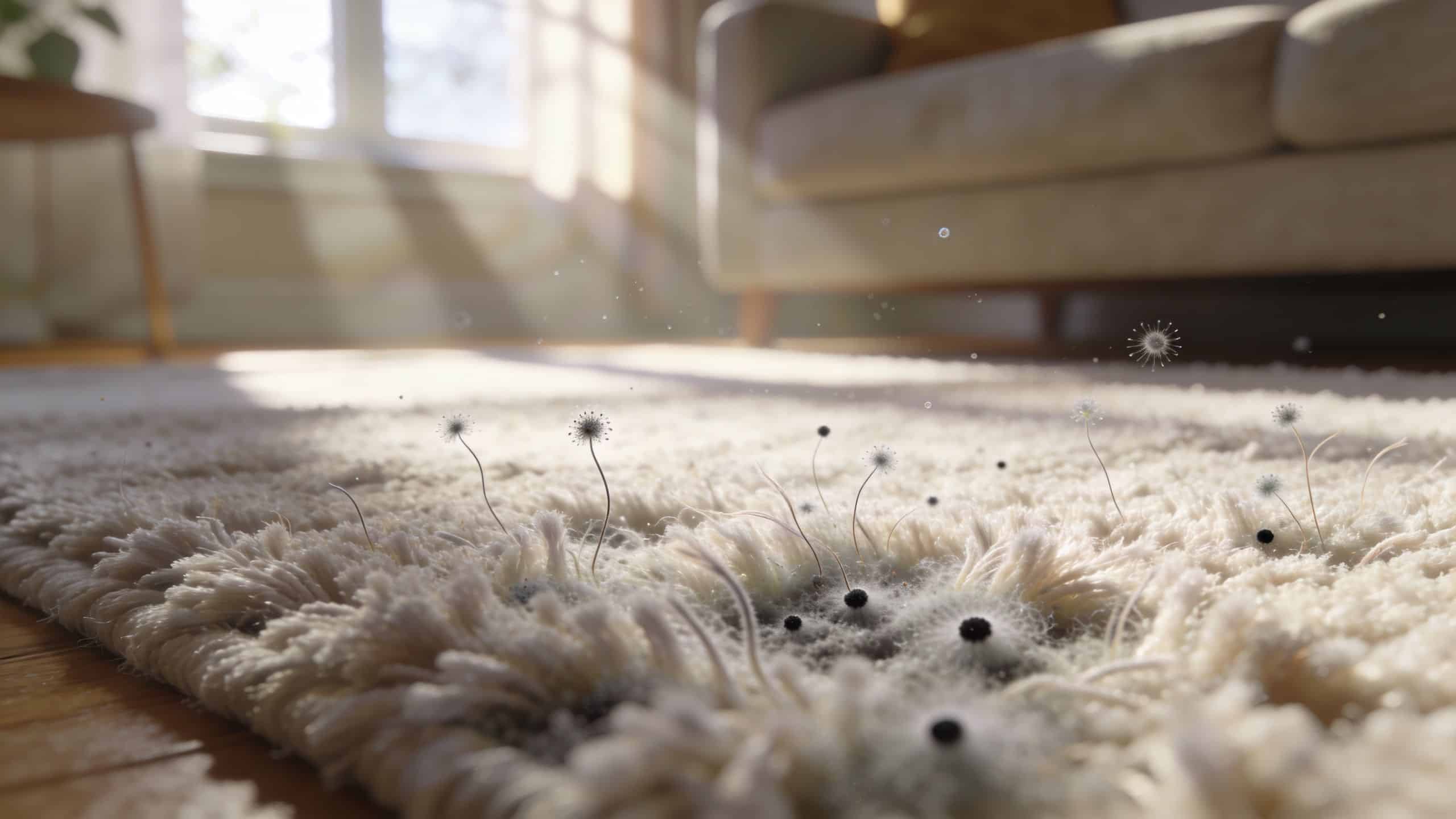
That matters in Melbourne because this angle is often overlooked. Australian data shows 1 in 5 Melbourne households report mould issues linked to high humidity, and a 2025 VIC Health report noted 25 per cent of respiratory cases in Greater Melbourne were tied to indoor mould, as highlighted in this discussion of holistic, carpet-inclusive mould remediation. Yet many homeowners still receive advice focused only on plaster, paint, and timber.
Why a standard vacuum won’t solve it
A household vacuum is designed for loose soil. It isn’t a remediation tool. If carpet has been exposed to moisture and airborne contamination, surface vacuuming may remove visible dust while leaving the deeper issue in the pile, the backing, or the underlay.
Upholstery has the same problem. A lounge can look clean and still hold odours and embedded contamination in the fabric and cushioning. That’s why the soft-furnishing part of mold professional removal needs specialist cleaning methods, not just room deodoriser and a quick once-over.
Where structural work and textile cleaning meet
The healthiest result usually comes from treating the room as one environment, not two separate jobs. Once the moisture source has been fixed and contaminated structural material has been dealt with, affected soft furnishings need their own decision.
That decision usually falls into one of three categories:
- Clean and restore when the item is salvageable and contamination is manageable
- Dry and deep clean when moisture exposure is the main concern
- Dispose of the item when contamination is too deep or the material can’t be safely recovered
For fabrics that can be restored, methods such as truck-mounted hot water extraction are often the right fit because they combine heat, flushing, and powerful extraction. If you’re dealing with fabric furniture specifically, this guide to removing mould from upholstery for good gives a useful breakdown of what can sometimes be cleaned and what shouldn’t be left to chance.
Cleaning the walls but ignoring the carpet is like showering after a smoky campfire and putting the same jacket straight back on.
The hidden reservoir problem
The phrase I use with homeowners is hidden reservoir. A room can look repaired while the carpet and furnishings still hold odour and settled spores. Then the family moves back in, closes the windows during a cold week, and the room starts smelling wrong again. They assume the mould returned. Sometimes it did. Sometimes the room was never fully reset in the first place.
That’s why carpets and upholstery matter so much. They’re often the last place people think to check, and one of the first places contamination lingers.
Keeping Mould Away for Good Prevention and Follow-Up Care
Once remediation is complete, the home needs new habits as much as it needs clean surfaces. The goal is to stop moisture building up in the same places and to avoid creating quiet pockets where air never moves.
Control moisture early
Moisture control is the main job. That means fixing leaks promptly, drying wet areas fast, and paying attention to the rooms that repeatedly collect condensation. Bathrooms, laundries, south-facing bedrooms, and rooms with heavy furniture against external walls usually need the most vigilance.
Ventilation is part of that. If your bathroom stays damp long after showers, it’s worth reviewing Templeton Built's ventilation advice to understand what proper extraction should achieve in everyday use.
Give air room to move
Homes get mouldy in still zones. A wardrobe packed tight against a cool wall, a couch pressed hard into a corner, curtains always closed, or a spare room shut for days at a time can all create microclimates where damp lingers.
A few simple habits help:
- Pull furniture slightly off external walls: Even a small airflow gap can reduce condensation build-up.
- Use exhaust fans properly: Let them run long enough to remove moisture, not just steam while you’re in the room.
- Open rooms regularly: Closed-up spaces tend to hold stale, damp air.
- Check after storms or leaks: Don’t assume a surface is dry because it feels dry to the touch.
Keep soft furnishings on the maintenance list
Carpets and upholstery need periodic deep cleaning, especially after damp events, musty odours, or recurring winter humidity. These materials hold what hard floors don’t. If you prefer lower-toxicity options for minor surface issues around the home, this guide to a natural mould killer is a helpful starting point for safe maintenance habits.
Prevention works best when you treat smell as an early warning, not a housekeeping nuisance.
Follow-up care doesn’t need to be complicated. Watch for condensation, keep moisture under control, maintain airflow, and don’t ignore musty odours in carpeted rooms. Most serious mould jobs start small. Catching them early keeps them that way.
If your home still smells musty, your carpets stayed damp after a leak, or you want a proper deep clean after mould treatment, Right Price Carpet Cleaning offers professional carpet and upholstery steam cleaning across Melbourne with truck-mounted equipment, straightforward pricing, and fully insured, police-checked technicians. It’s a practical next step when you want the whole room to feel clean again, not just the walls.
Recent Comments