


There are three main ways to clean a rug: dry cleaning with low-moisture products, steam cleaning (hot water extraction) on your floor, or full immersion washing at a rug cleaning facility. They aren’t interchangeable, and they don’t get the same amount of dirt out. Ranked from least to most thorough, it goes:
- Dry cleaning: an interim clean that only reaches the surface.
- Steam cleaning: a good freshen-up for lightly soiled rugs, cleaning the pile from the top down.
- Full immersion washing: the only method that cleans a rug right through, including the foundation and backing.
Below we explain how each method works, what it can and can’t fix, and how to work out which one your rug needs. We offer in-home rug steam cleaning and off-site rug washing in Melbourne, and we wash rugs at our own rug wash facility in Melbourne, so this is how we decide for our own customers.
The Three Methods at a Glance
| Method | How it works | What it reaches | Best for | Not suited to |
|---|---|---|---|---|
| Dry cleaning (low-moisture) | A dry compound, foam or pad is worked into the surface, then vacuumed out | The surface fibres | An interim tidy-up between proper cleans, or rugs that can’t take water | Deep grit, heavy soiling, pet urine and odours |
| Steam cleaning (hot water extraction) | Hot water and a cleaning solution are injected into the pile and extracted straight away, with the rug on your floor | The pile, from the top down | Lightly soiled synthetic rugs with no smell | Pet urine, odours, heavy soiling, and viscose, sheepskin, jute, sisal and cotton rugs |
| Full immersion washing | The rug is dusted, pretreated, washed and rinsed right through at a facility, spun out in a centrifuge and dried under controlled conditions | Pile, foundation and backing | Pet urine, odours, heavy soiling, and wool, Persian, silk and other natural fibre rugs | A same-day refresh (the rug is away for 7–10 days) |
Dry Cleaning a Rug: An Interim Clean Only
“Dry” cleaning is a bit of a misnomer, because most methods still use a little moisture. The common ones are:
- Dry compound: absorbent granules, lightly dampened with a cleaning solution, are brushed into the pile to soak up soil, then vacuumed out.
- Encapsulation: a foam or liquid is worked in and dries into crystals that trap the dirt, which are vacuumed up later.
- Bonnet cleaning: a damp pad is spun across the surface to lift soil from the tips of the fibres.
All of them clean the surface and nothing more. They don’t remove the sand and grit that settle at the base of the pile and wear the fibres down, and they can’t reach urine in the foundation. Some products also leave a residue that attracts dirt if it isn’t fully removed.
That’s why we treat dry cleaning as an interim clean: something to tidy a rug up between proper cleans, not a replacement for one. Many people who search for “rug dry cleaning” actually want a careful, thorough clean that won’t damage a good rug, and for most rugs that’s a wash. We only dry clean a rug when there’s no other option, such as dyes that won’t hold up to water.
Steam Cleaning a Rug: Good for a Light Freshen-Up
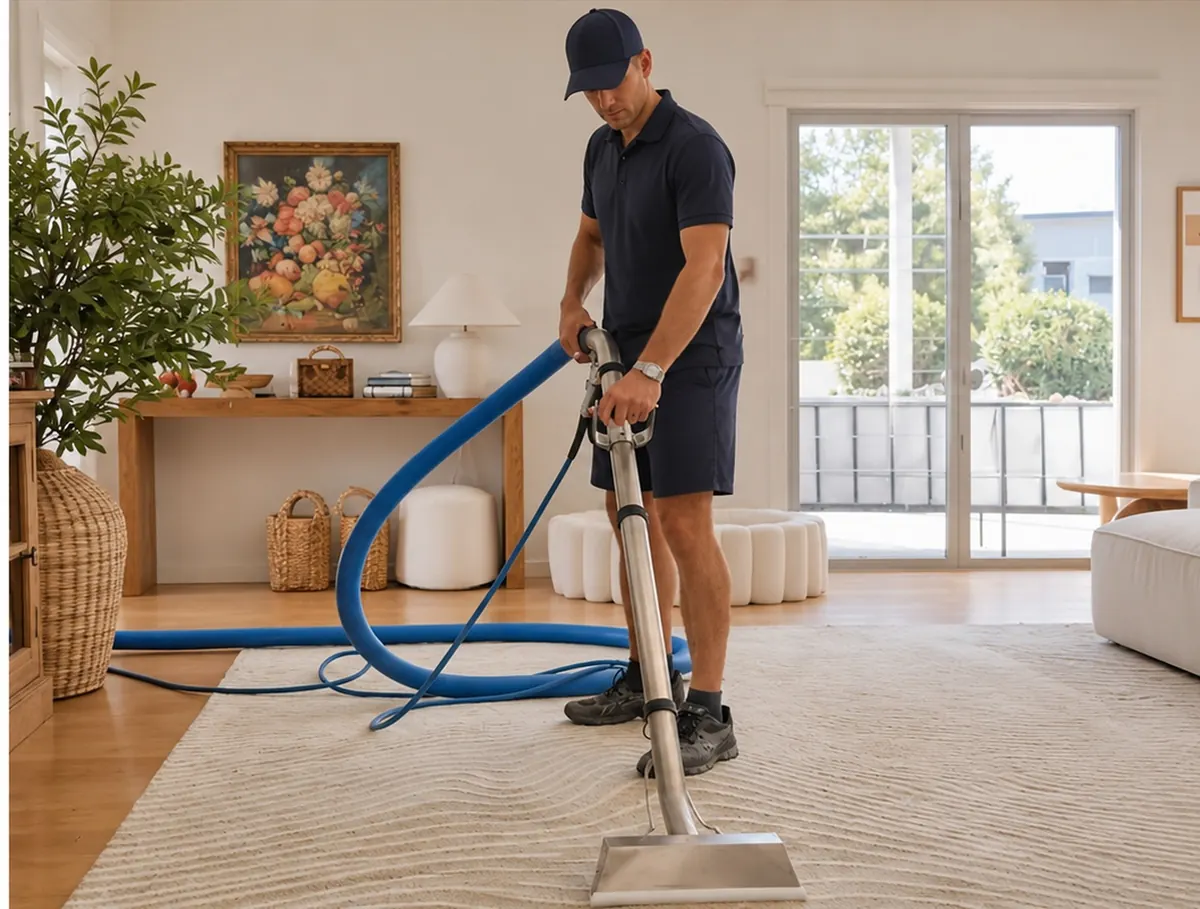
“Steam cleaning” is the everyday name for hot water extraction, the same method used on carpets. Heated water and a cleaning solution are sprayed into the pile and pulled straight back out with strong suction, taking the loosened dirt with it. Despite the name, nobody is blasting clouds of steam into your rug.
Done in your home, it’s quick and easy. The rug is cleaned in the same visit as your carpets or couch, and most rugs are dry in 8–12 hours.
The limit is that the rug stays on the floor. The water can only be extracted from the top, so anything that has soaked down into the foundation or backing, such as pet urine, a large spill or years of fine grit, mostly stays there.
When we recommend it: a synthetic rug (polypropylene, nylon, polyester) that’s lightly soiled and has no smell. We’ll also steam clean a lightly soiled wool rug in your home if that’s what you’d prefer, although we usually recommend washing wool.
Rugs we won’t steam clean: viscose (also sold as art silk), sheepskin, jute, sisal and cotton. These fibres can brown, shrink, water-mark or lose their texture when they’re wet cleaned on the floor, so they’re always washed at our facility instead.
Our in-home rug steam cleaning is $50 per rug up to 2×2 m, with a $150 minimum per visit, so it’s easiest to add to a carpet or upholstery clean.
Full Immersion Washing: How We Wash a Rug
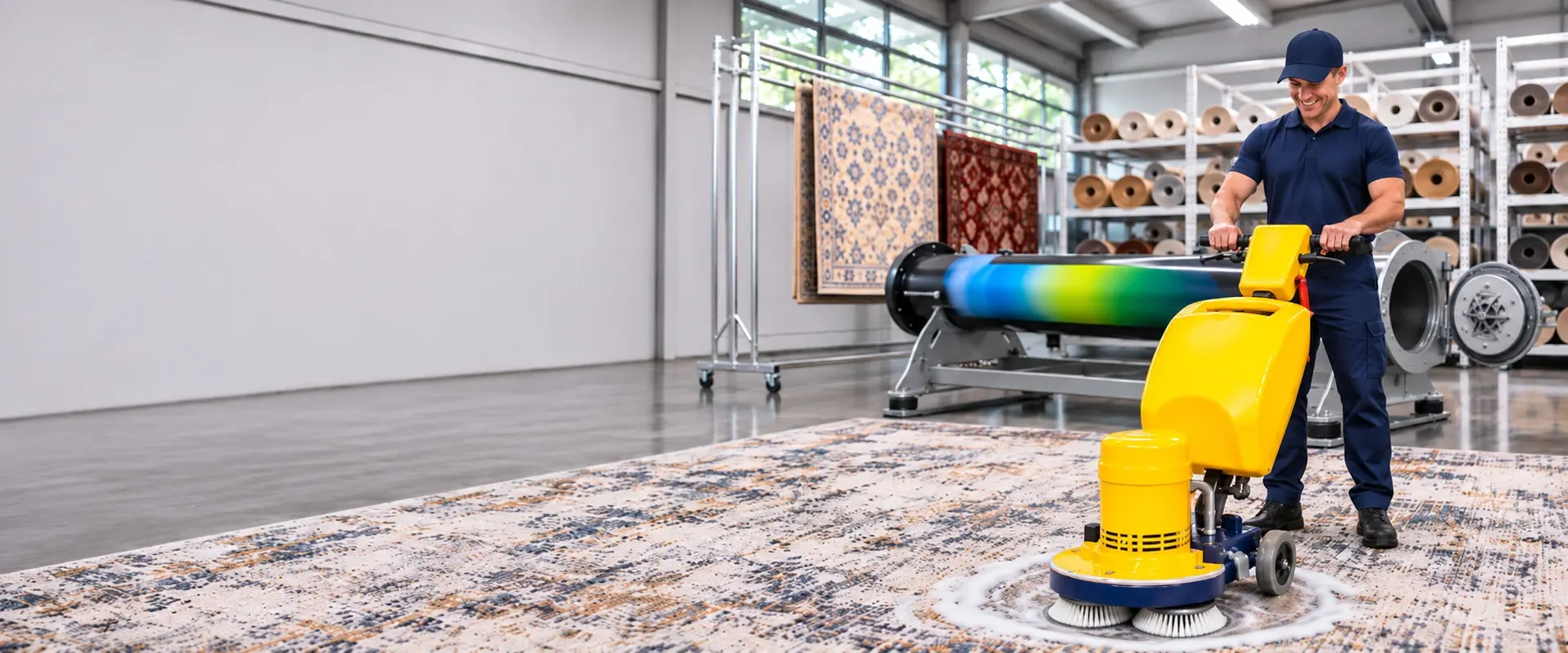
A proper rug wash can’t be done on your floor. We wash rugs at our own facility in Melbourne, and every rug goes through the same steps:
- Inspection: the rug is measured, photographed and tagged. We check the fibre, the type of backing, its condition, and any stains, pet urine or damage. Some rugs are tested for colour bleeding before they can be washed.
- Dusting: before the rug gets wet, we get as much dry dirt out as possible. A rug duster (we use a Rug Badger) vibrates and beats the rug to loosen the sand, grit and dust trapped deep in the pile, then the rug is vacuumed.
- Pre-treatment and soaking: stains and heavily soiled areas are treated first. Rugs with pet urine or strong odours may be soaked in a cleaning solution to break down the contamination. How long depends on the fibre, how the rug is made and how dirty it is.
- Washing: the rug is laid out on our wash floor, thoroughly wetted, and the cleaning solution is worked into the fibres with a rotary scrubber. Depending on the rug, the backing is washed too.
- Rinsing: we rinse with high-pressure water, squeegees and extraction equipment, and keep going until the rinse water is reasonably clear and as much cleaning residue as possible is gone.
- Centrifuge: the wet rug is rolled up and spun at high speed in a long cylindrical centrifuge, which forces out a large amount of water in a short time.
- Grooming: the pile is brushed back into place, the fringes are straightened, and any area that needs extra attention is treated.
- Drying: the rug is hung on racks or laid flat, depending on the type, with air movers, dehumidifiers and sometimes heaters. The whole rug has to dry, including the backing, because moisture trapped inside a rug leads to odours and browning.
- Final inspection: once it’s completely dry, we check it again for stains, odours, browning or colour changes, then vacuum and groom it again. If something hasn’t cleaned up properly, it gets further treatment.
- Delivery: the rug is rolled, labelled and packaged, and we deliver it back to your door.
The dusting step is a big part of why washing works. Grit that a vacuum can’t reach turns to mud the moment it gets wet, so getting it out dry first makes the wash far more effective. And because the whole rug is washed and then properly dried, washing deals with problems steam cleaning can’t reach: pet urine in the backing, musty or smoky odours, heavy soiling and deep grit.
What can hide in a rug that doesn’t look dirty
One rug we washed didn’t look too bad at first: a bit grubby, nothing unusual. That changed once we started. It was full of pet urine, and the smell really came out once it was wet. Even after a thorough dusting, the water turned almost black as soon as we started washing it, and we kept rinsing while the dirty water kept coming: sand, dust, pet hair, urine and years of built-up grime.
By the end, the colours were much brighter, the pile felt softer and the urine smell was gone. It’s a good example of how much can be hiding in a rug, even one that doesn’t look particularly dirty, and why a surface clean would only have touched the top of it.
Washing takes longer: the rug is away for 7 to 10 days, and we collect it and deliver it back for free. Our professional rug wash with free pickup is $45 per m² for synthetic rugs, $55 per m² for natural fibres such as wool, Persian, oriental, sheepskin, viscose, jute, sisal and cotton, and $75 per m² for silk, with a $180 minimum. For example, a 2 m × 3 m wool rug is 6 m² × $55 = $330, with pickup and delivery included.
Which One Does Your Rug Need?
By rug type
| Rug | What we recommend | Why |
|---|---|---|
| Synthetic (polypropylene, nylon, polyester), lightly soiled, no smell | In-home steam clean | Synthetic fibres handle hot water extraction well, and a light clean doesn’t need to reach the backing |
| Synthetic, heavily soiled or with urine or odour | Wash | The problem is below the surface, where extraction on the floor can’t reach |
| Wool | Wash (a light in-home steam clean is fine if it’s only lightly soiled and you prefer it) | Wool holds a lot of soil deep in the pile. See our guide to cleaning wool carpet and wool rugs |
| Persian and oriental | Wash | Usually hand-knotted, often with natural dyes, so the dyes need testing and the foundation needs a thorough rinse |
| Silk | Hand wash | The most delicate fibre we clean. Silk is always hand washed |
| Viscose (art silk) | Wash, never steam cleaned | Viscose can water-mark, lose its sheen or brown if it’s wet cleaned on the floor |
| Sheepskin and lambskin | Wash, never steam cleaned | They need a gentle wash and slow, careful drying |
| Jute, sisal and cotton | Wash, never steam cleaned | Plant fibres can brown or shrink if they’re left damp, so drying has to be controlled |
By problem
- Dull or grubby synthetic rug in a busy room: an in-home steam clean is usually enough.
- Pet urine or a urine smell: a wash. Urine soaks through to the backing, which steam cleaning can’t reach. If it’s just happened, start with our guide on what to do when a dog pees on your rug.
- Musty, smoky or stale smell: a wash, so the whole rug is cleaned and properly dried.
- Allergies or a dusty house: a wash, because dusting and washing right through remove the fine dust that sits deep in the pile.
- Dyes that won’t hold up to water: a low-moisture clean after inspection.
When steam cleaning isn’t your only option
A customer once had a beautiful old wool rug with heavy urine contamination. She didn’t realise the smell could be removed and thought steam cleaning was her only choice. We washed it instead: the smell was removed, and the colours were vibrant again, the way they’d been many years earlier.
Not every rug comes up like that. How well a urine stain comes out depends on the fibre, the dyes, and how old and heavy the urine is, and we’ll tell you what to expect when we inspect it. But if you’ve been told a rug is past saving, or you think a quick steam clean is all you can do, it’s worth asking about a wash first.
Is It Okay to Steam Clean an Oriental or Persian Rug?
We don’t recommend it. Most oriental and Persian rugs are hand-knotted wool on a cotton foundation, often coloured with natural dyes. In-home hot water extraction can’t rinse the foundation, and too much heat or the wrong detergent can make the dyes bleed. A rug that’s left damp underneath can also brown or start to smell musty, and the fringes usually need careful hand cleaning.
A wash, where the dyes are tested first and the rug is dried properly, is the safer choice for anything valuable.
How Often Should You Clean a Rug?
- Vacuum it weekly, and more often in busy areas. Turn it over and vacuum the back every so often, because grit works its way through. Keep the beater bar off fringes and shaggy pile.
- Rotate it every few months so it wears and fades evenly.
- Get it professionally cleaned every 12 to 18 months as a rough guide for a rug in a quiet room, and more often for living areas and hallways, or if you have pets or someone at home has allergies.
Don’t wait until a rug looks dirty. As the rug in our story above showed, grit and contamination build up deep in the pile long before they show on top.
Frequently Asked Questions
Is dry cleaning better than washing for a rug?
No. Dry cleaning is an interim clean that only reaches the surface, while full immersion washing cleans the whole rug, including the foundation and backing. Dry cleaning is only the better choice for the rare rug whose dyes won’t hold up to water.
Which rug cleaning method gets the most dirt out?
From least to most: dry cleaning, then steam cleaning, then full immersion washing. Washing is the only one that dusts the grit out first and then cleans right through the rug.
Can you steam clean a wool rug?
Yes, if it’s only lightly soiled and has no smell, and we’ll do it in your home if that’s what you prefer. For a properly clean wool rug, though, we recommend washing. Wool holds a lot of soil deep in the pile, and a wash reaches it.
Which rugs should never be steam cleaned?
We won’t steam clean viscose (art silk), sheepskin, jute, sisal or cotton rugs. They’re always washed at our facility, where the process and the drying can be controlled.
Will water damage a wool rug?
Not when it’s washed properly. Wool rugs are traditionally washed with water. Damage comes from harsh detergents or from leaving the rug wet for too long, which is why we spin rugs out in a centrifuge and dry them, backing included, under controlled conditions.
Does steam cleaning get pet urine out of a rug?
It can help with a fresh accident on the surface, but not with urine that has soaked into the backing. A wash removes the odour. Whether the stain comes out completely depends on the rug’s fibre and dyes, and on how old and heavy the urine is.
How long does each method take to dry?
After an in-home steam clean, most rugs are dry in 8–12 hours. Low-moisture methods dry faster because they use so little water. Washed rugs are dried at our facility, and the whole service takes 7 to 10 days from pickup to delivery.
Can I wash a rug at home?
Small synthetic rugs with a care label that says they’re machine washable, yes. Wool, silk, viscose, Persian, oriental and sheepskin rugs shouldn’t go in a washing machine or under a hose. Those are the rugs most easily ruined by DIY washing.
Not sure which your rug needs? Get an instant price on our rug cleaning Melbourne page and book online. We inspect every rug before we clean it, and if a different method would suit it better, we’ll tell you.