



Morning light is brutal on neglected glass. A window can look passable at dusk, then the sun swings around and suddenly every smear, salt mark and dusty drip line is on display. In Melbourne, that shock usually isn’t just cosmetic. It’s a sign your exterior glass is carrying a mix of coastal residue, traffic film, construction dust and seasonal pollen that generic cleaning advice doesn’t handle well.
Washing exterior windows properly means treating the dirt you have, not the dirt a general how-to assumes. Melbourne homes near the bay deal with salt. Inner and middle suburbs pick up urban grime. Leafy areas get hammered by pollen and organic residue. Add hard water in parts of Greater Melbourne, and it’s easy to end up with streaks that seem to reappear the moment the glass dries.
Why Crystal-Clear Windows Matter in Melbourne
A common Melbourne scene goes like this. You open the blinds, expecting a clean view over the street or backyard, and instead the glass looks cloudy even though you wiped it not that long ago. From inside, it can look like dust. From outside, it’s usually a layered mess of salt haze, airborne grime and water spotting.

Melbourne’s conditions are hard on exterior glass. Exterior windows often need washing every 1 to 2 months because salt spray and urban pollution make grime build up up to 40% faster than in inland rural areas, and that cleaning frequency helps prevent permanent etching on glass surfaces, according to Student Works Window Cleaning’s cleaning frequency guidance.
Dirt isn’t the only problem
People often treat window washing as a visual tidy-up. In practice, it’s part of routine maintenance. Salt and fine grit sit on the surface, and if you scrub aggressively or leave buildup in place, you increase the chance of scratching and dulling the finish over time.
That matters more on modern homes with larger panes, more exposed façades and expensive glazing. Once the glass starts looking permanently tired, no miracle spray fixes it. Good technique protects the pane. Bad technique can age it faster.
Practical rule: If the window looks filmy after light rain, it usually isn’t “clean enough already”. Rain redistributes contamination. It doesn’t remove it.
Melbourne makes timing matter
The city’s weather also tricks people into poor cleaning decisions. A bright mild day feels ideal, but direct sun dries solution too fast. Wind pushes dust back onto damp glass. Pollen season adds another layer entirely, especially in greener suburbs where the glass picks up a yellowish or hazy coat that doesn’t respond well to a quick wipe.
For homeowners, renters and property managers, the takeaway is simple:
- Clean before buildup hardens: Old grime is harder to remove and more likely to leave marks.
- Match the method to the residue: Salt, pollen and hard water spots don’t behave the same way.
- Treat window washing as upkeep: It protects the appearance of the home and the condition of the glass.
Gathering Your Professional-Grade Toolkit
Most streak problems start before the cleaning begins. The wrong cloth, an over-foamy mix, a tired squeegee blade or a household spray that leaves residue will make the whole job harder than it needs to be.
A workable kit doesn’t need to be fancy, but it does need to be deliberate. For washing exterior windows, I’d rather see a simple professional setup than a cupboard full of supermarket sprays.
What actually belongs in the kit
The essentials are straightforward:
- A quality squeegee: The rubber blade matters more than the brand name. If the edge is nicked or hardened, it will leave lines.
- A strip washer or applicator mop: This puts solution on evenly and loosens grime better than a folded rag.
- Two buckets: One for your cleaning mix, one for rinsing dirty tools.
- Lint-free microfiber cloths: Professionals favour these because paper towels leave residue. In hard-water areas, a 1:1 white vinegar-to-water mixture is also more effective than soap alone for preventing mineral spotting, as noted by Professional Window Cleaning’s technique guide.
- A soft brush or dry detailing cloth: Good for loose cobwebs, dirt on frames and sill edges.
- An extension pole if needed: Better reach, less overreaching.
What to avoid
Some tools create more work than they save.
| DIY Eco-Friendly Cleaning Solution Comparison | Best For | Recipe |
|---|---|---|
| Mild dish soap mix | General road grime and routine washes | One teaspoon of mild dishwashing soap per 5-gallon bucket of warm water |
| Vinegar and water mix | Hard water spotting and heavier mineral residue | 1:1 white vinegar to water |
| Spot treatment with vinegar or rubbing alcohol | Localised mineral deposits or stubborn marks | Apply directly to problem areas before the main wash |
Skip these common mistakes:
- Paper towels: They shed lint and drag residue around.
- Ammonia-heavy cleaners: These can be too harsh for some modern coated glass.
- Overly sudsy mixes: More foam doesn’t mean more cleaning. It usually means more detailing later.
- Dirty rags reused from other jobs: Window glass shows contamination immediately.
Dirty tools don’t “sort of” work on glass. They advertise every shortcut.
A note on water and pressure
If you’re cleaning around sills, brickwork or exterior cladding as part of the job, pressure has to stay controlled. High pressure too close to frames can force water where it shouldn’t go or mark surrounding surfaces. If you’re using water pressure anywhere near the window area, it helps to understand the basics of cleaning with high pressure water before you start.
For the glass itself, keep the process gentler. Window cleaning is mostly about lubrication, technique and clean finishing, not brute force.
A sensible Melbourne-ready setup
For most homes, this combination works well:
- Routine grime: Dish soap mix, applicator, squeegee, microfiber.
- Mineral spotting: Vinegar mix, short dwell time, then standard wash.
- Delicate coated glass: Mild solution, soft applicator, no abrasive pads.
That last point matters. If you aren’t sure what coating or glass type you have, treat it as sensitive until proven otherwise.
The Pro Method for a Streak-Free Finish
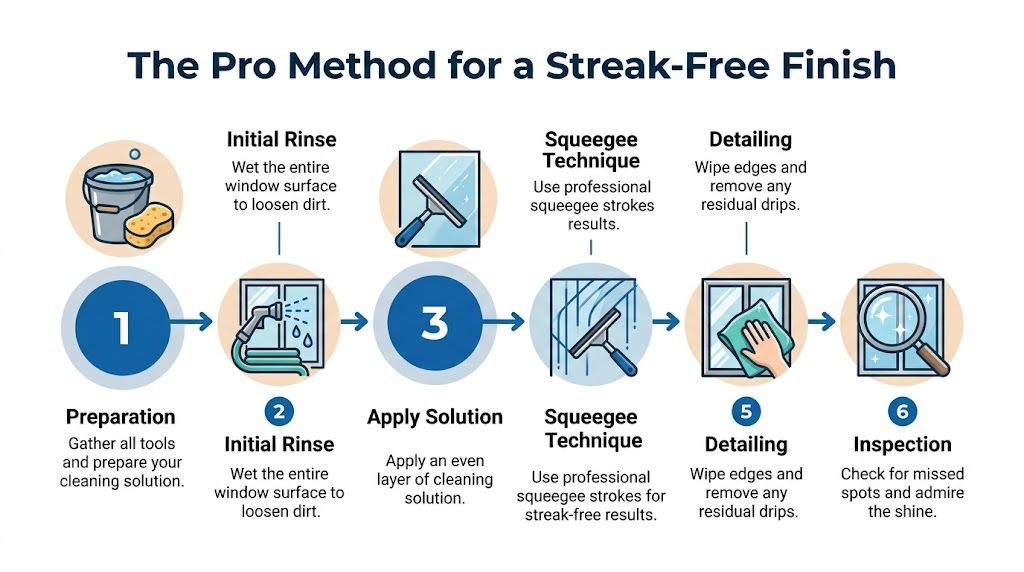
The difference between an average result and a professional-looking one usually comes down to sequence. Good window cleaners don’t just wash and wipe. They control contamination from the first rinse to the final edge detail.
Start with a proper pre-rinse
Exterior glass collects loose grit. If you go straight in with a sponge or scrubber, that grit becomes an abrasive. The first step is a hose spray-down with adjustable nozzle pressure to remove loose debris.
Keep it controlled. Wet the glass thoroughly, but don’t blast seals, frames or surrounding materials. If you’re working near painted trim or older timber, lower pressure is the safer choice.
Apply solution to the tool, not the pane
This is a detail a lot of DIY jobs miss. Apply your cleaning solution to the dampened sponge or strip washer rather than flooding the window itself. That keeps the pane from becoming oversaturated and gives you better control over drips.
Then scrub from top to bottom using light-to-moderate pressure. Use a mix of up-and-down and side-to-side motion, especially on corners and lower edges where grime tends to sit.
Use the dry-edge technique
This is one of the trade secrets that earns the label. Before you squeegee, wipe a one-inch strip along one side of the window to create a dry edge. That step prevents water from re-contaminating the edge during the final pass. It’s a critical part of a streak-free result, and it works best when you clean on cloudy days or while the glass is shaded, as explained in Window Genie’s guide to outside window cleaning.
A clean dry edge gives the rubber blade somewhere safe to start. Without it, you drag dirty water back into the finish line.
Squeegee with overlap, not speed
Fast isn’t the goal. Clean control is.
Use a single smooth stroke pattern with about one inch of overlap between passes. That overlap stops thin water lines from being left behind. Keep the blade angle consistent, and wipe the blade as needed so you aren’t carrying dirty solution across the next pass.
A practical workflow looks like this:
- Set the blade at the top corner: Start against the dry edge.
- Pull smoothly: Don’t chatter or stop halfway unless the pane shape forces it.
- Overlap the next pass: Slightly cover the previous path.
- Finish before the water sits: The final buffing and water removal should happen quickly so mineral residue doesn’t have time to settle.
If you want a second reference point on tool handling and sequencing, this expert window cleaning guide gives a useful companion overview of professional habits that support a cleaner finish.
Detail the edges and inspect properly
After squeegeeing, wipe the perimeter and sill with a dry microfiber cloth. Don’t use the same soaked cloth you had in your pocket for the whole job. That just reintroduces moisture and grime to the frame line.
For quality control, professionals often use horizontal passes on one side of the glass and vertical passes on the reverse. That makes it easier to tell whether a remaining streak is inside or outside. It sounds minor, but it saves time when you’re checking your own work.
The method that usually fails
The least effective pattern is also the most common. People spray multiple panes, chat for a minute, then come back with paper towel or a cloth and try to polish the mess away. By then the solution has dried unevenly, dirt has shifted to the edges and the finish is already compromised.
The professional method works because every step supports the next one:
- Pre-rinse removes grit
- Controlled application lifts grime
- Dry edge improves the squeegee start
- Overlapping passes clear water cleanly
- Immediate detailing stops drip marks
That’s how washing exterior windows goes from frustrating to predictable.
Advanced Tactics for Tricky Windows and Seasons
The awkward jobs are where generic advice falls apart. Melbourne has plenty of them. Second-storey panes over a sloping path, louvres that catch grime on every edge, and spring windows coated with fine pollen that behaves more like abrasive dust than soft debris.
High windows without bad ladder decisions
If a window can’t be reached without leaning sideways off a ladder, stop there. That setup is already wrong. Use an extension pole for the applicator and squeegee where possible, or work from inside on suitable double-hung windows if the design allows exterior access through a tilt function.
Good high-window practice usually means:
- Set up square to the work: Don’t reach across.
- Move the ladder often: It’s slower, but much safer.
- Use poles for finishing strokes: Especially on large fixed panes.
- Avoid windy conditions: Pole work gets sloppy fast when the tool starts drifting.
Pollen season needs a different touch
During Melbourne’s peak pollen season from October to March, airborne pollen can reach 200 to 500 grains/m³, and that buildup can scratch glass if it’s scrubbed dry. A low-pressure pre-rinse is recommended to neutralise the film before washing, according to Insight Service Solutions’ exterior window advice.
That point matters because pollen residue often looks harmless. It isn’t. On glass, it can act like a very fine abrasive, especially once it mixes with dust and dries into a film.
If the pane looks powdery or hazy in spring, rinse first. Never attack it dry with elbow grease.
Seasonal adjustments that actually help
Melbourne windows don’t stay dirty in the same way year-round. A better routine changes with the conditions.
Spring and summer
Pollen, insect marks and dry dust are the main issues. Pre-rinse first, then wash gently. If you see a yellow-green film, don’t assume more pressure is the answer.
After rain and windy spells
Windows often dry with redistributed grime rather than a clean surface. Inspect lower edges and corners, where residue tends to collect.
Hard water marks on exposed panes
If sprinklers, hose overspray or repeated rinsing have left deposits, spot treatment is usually better than aggressive full-pane scrubbing. For stubborn mineral residue, this guide on removing hard water stains is a useful companion because the same mineral logic applies to glass surfaces around the home.
Different window types need different handling
Not every pane should be approached the same way.
- Double-hung windows: If they tilt inward, use that feature. It can eliminate the need for a ladder on upper floors.
- Louvred windows: Clean blade by blade. Rushing them leaves dirty edges behind.
- Large fixed panels: Pole work helps, but only if the rubber blade stays clean and the pole isn’t flexing too much.
The better you match the technique to the window style and the season, the less effort you waste correcting avoidable streaks later.
Troubleshooting Common Window Washing Problems
Sometimes the method is mostly right and the finish still looks wrong. Usually that means one small part of the process is letting you down. Window glass is unforgiving that way.
You’re seeing streaks after the glass dries
The first assumption is often “I need a stronger cleaner”. Usually, you don’t. Streaks are more often caused by dirty water, a worn squeegee edge, overused cloths or working on glass that’s too hot.
Check these first:
- Blade condition: A nicked rubber edge leaves repeating lines.
- Drying speed: If the pane dries before you finish, residue gets left behind.
- Cloth contamination: Fabric softener, lint and old grime all show up on glass.
A simple fix is to slow the process down and work one window at a time in the shade.
White spots keep coming back
Those spots are usually mineral deposits, not missed soap. They often appear once the pane is dry, which makes people think they somehow created them during cleaning. In reality, the minerals were already there.
Try this approach:
| Problem | Likely cause | Best fix |
|---|---|---|
| White spotting | Hard water residue | Spot treat affected areas, then rewash |
| Streak lines | Squeegee issue or hot glass | Replace rubber or work in shade |
| General haze | Residue from cleaner or dirty water | Use fresh solution and clean microfiber |
The glass looks hazy, not dirty
Haze is different from streaking. It usually means residue has been spread very thinly across the pane. Common causes include too much soap, paper towel lint, dirty applicators or using a general-purpose household cleaner that leaves a film.
Quick test: View the glass from an angle, not straight on. Residue and haze show up faster that way.
If the haze is only on one side, isolate the issue before redoing the whole job. That’s where a disciplined pass pattern helps.
Corners and edges look worse than the middle
This is nearly always a finishing problem. Water creeps into the frame edge, then dribbles back onto the glass after you think you’re done. A dry microfiber cloth on the perimeter solves most of it, but only if the cloth is dry.
For recurring edge drips, clean the sill and frame line more thoroughly before the final detail. Dirt hiding there often reactivates as soon as fresh water hits it.
When to Skip DIY and Hire a Professional
DIY works well for accessible windows, light buildup and people who are comfortable with the process. It stops making sense when access, risk or staining gets beyond what standard tools can handle.
For Melbourne commercial properties, professional quarterly exterior window cleaning can boost property value by up to 52%, and neglected residential windows can block up to 12% more natural light, which can push annual energy bills higher, according to IBISWorld’s industry overview citing the Melbourne market context.
The jobs that usually justify a pro
Hire help when the issue is less about effort and more about exposure or complexity:
- Three-storey or difficult-access windows: The risk climbs much faster than the cleaning benefit.
- Heavy mineral staining: Basic DIY kits often won’t shift it cleanly.
- Large commercial frontages: Consistency matters, and the time cost is substantial.
- Combined exterior maintenance jobs: If the windows are dirty because gutters and roof edges are shedding grime, broader exterior upkeep may be the true answer. In that case, these professional gutter and roof cleaning services are a relevant example of the kind of support that can stop the problem at the source.
It’s not giving up. It’s choosing the right method
A professional should bring insured access equipment, proper water control and a system that gets through the work efficiently. That matters for body corporates, end-of-lease cleans and homes with awkward upper glazing.
If you’re comparing options for broader home or tenancy cleaning support, it also helps to review established cleaning services in Melbourne so you can bundle tasks sensibly instead of organising multiple separate visits.
Frequently Asked Window Cleaning Questions
Some of the most important window cleaning questions aren’t about the basic wash. They’re about modern glass, safety and avoiding accidental damage.

Can I use vinegar on Low-E windows
Yes, but only in the right dilution. Low-E coatings are found on 70% of new Victorian builds, and ammonia-based cleaners can scratch them. A diluted 1:10 vinegar solution is safe, while undiluted vinegar or abrasives can damage the coating and reduce energy efficiency by up to 25%, according to Milestone Windows’ guidance on exterior window cleaning.
The practical takeaway is simple:
- Use mild dilution only
- Avoid abrasive pads
- Never assume tinted or coated glass can handle standard supermarket sprays
Is a pressure washer safe for windows
Usually, pressure is safer around windows than directly on the glass. If you’re cleaning nearby surfaces, use the lowest effective pressure setting and keep the nozzle at least 12 inches from the surface. That reduces the chance of damaging frames, trim and seals.
For the pane itself, standard window tools are the better choice. A controlled wash and squeegee finish gives you more precision and less risk.
What if my ladder feels unsafe
Trust that instinct. If the ladder feels unstable, the footing is poor or the reach is awkward, stop. Use an extension pole, clean tilt-in windows from inside where possible, or book a professional with water-fed access tools.
What’s the safest cloth for detailing
Use lint-free microfiber cloths. They absorb cleanly, don’t leave fibres and work far better than paper towels for edge detailing and final buffs.
Glass rewards clean tools and punishes rushed decisions.
Should renters handle exterior windows themselves before inspection
Only if the windows are safely accessible and the glass type is straightforward. On newer rentals with coated glazing, aggressive DIY can do more harm than good. If there’s any doubt about access or coating sensitivity, ask before experimenting.
If you’d rather hand the hard work to a local team, Right Price Carpet Cleaning helps Melbourne homes, rentals and commercial spaces stay cleaner with professional steam cleaning for carpets, rugs, upholstery, mattresses and more. They’ve been serving Greater Melbourne since 2007 with insured technicians, straightforward pricing and eco-friendly pretreatments, which makes them a practical choice when you want the rest of the property looking as fresh as the windows.
Recent Comments